Shades of green

Three weeks in my new job, and I have already concluded that the grass is not greener on the other side, it is just of another shade. The most important is to reflect on what attitude I bring to that environment.

Any work environment is a system, and no human-created system is perfect. Some systems are directly rotten, and luckily for me, I did not end up in such an environment. Most systems are well-functioning in spite of their flaws and lacks. Over the years, I have identified myself as someone who always sees areas of improvement which is a rather positive way to say that I often see where problems are. I don’t do this on purpose, it is part of my mindset. Don’t ask me where it comes from. This can be an asset if I don’t get stuck in the frustration of what I see as a problem, and if I can actually do something to improve it but it can also be a curse if I get mentally fixated, but can’t do anything to change it. The same way, I have a tendency to pay more attention to my shortcomings than what I do well.

Awareness on these two thinking patterns, has led me to make an agreement with myself. On the professional plan, I made a choice of changing environment, and I am committed to do my best to thrive. Reflecting on what sometimes brought frustration and stress in my previous work, I think that a lot could have been avoided if I had chosen to put my energy elsewhere. Among other things, focus more on what I do and how I do it, be more assertive, and let go of what I have no control over.

I am trying also to change my mindset when it comes to myself. I honestly believe that one of the things that makes life worth living is to be a life long learner, to develop the skills we have and acquire new ones, but also develop spiritually. Fot this, I need to find a better balance between observing my limiting actions and attitudes with the purpose to let go of them, and observing my qualities and skills to build myself up from them. If I only focus my attention on what I see as flaws and shortcomings, I feel I just put more pressure on myself.

Furthermore, I believe that if I manage to change this mindset, I will also be able to see more what is positive around me instead of what needs to be “fixed”.

Changes are a very good oportunity to reflect on what we want to bring to the new environment that helps us further, and what we need to let go of that hasn’t helped us so far. So, the grass might be healthier on the other side, but if we bring along what dammaged the grass where we were at, we will soon be looking over the fence wondering if there is an even greener grass somewhere else.

This said, I acknowledge that sometimes, it takes several jumps to finally find the place where we feel we can better contribute and thrive. Luckily for me, I think I have landed in a fertile environment where there is room for learning and staff is very supportive. Now it is up to me what I do with this opportunity, to find my place and an area where I can contribute.

On time and mindful living

I have been trying to simplify my approach to life with the intention to create slience and thus peace of mind. I realize I have been exposed to many different concepts within the Yoga and Buddhist traditions that resonate with me, but I haven’t been able to internalize them in such a way that they really make a difference in my state of mind. Even worse, I suspect I have been using them to put more pressure on myself as I wrote in my previous post resulting in more overthinking.

During the last three weeks, every time I start stressing about something, I have reminded myself of the power of silence, and since I am not able to create complete silence in my mind yet, I do my japa (repetition of a chosen/given mantra with focus on my breath). It has sometimes helped by slowing down the constant stream of thoughts that tend to just go in circles. Following this intention, I started reflecting on where my thoughts usually go, and not surprisingly, they are either in the past like regretting something I did or didn’t do, trying to understand why someone said or did something, longing for something I enjoyed that no longer is, and repeating a situation that brought stress or distress- what we call ruminating; or in the future like planning for whatever is coming, but not only that, also imagining the worst case scenarios and dreading them. My fear is mostly not being able to cope with them. But when am I in the present? And what would bring to be in the present? Well, if you’re reading this blog post, you are most probably familiar with the concepts of “mindfulness” and “mindful living”. It’s power lies in letting go of the past to be completely present in the moment with a fresh mind free from judgement and prejudice. It allows us to better notice our role in the now, and to save energy from dreading what might come. So, why do we keep traveling with the mind back and forward? I honestly don’t know. Personally, I think it is connected to fear and lack of trust in myself. How do I build that trust? I think it goes back to silencing my mind, and repeating my japa. I have tried to use “reason” against my anxious thoughts. To list the moments I have been challenged and managed to get through. It doesn’t help. The best I can do with my own mind is to not engage in the stream of overthinking.

I am also learning to better be with my emotions without trying to change them but without elaborating on them either. So, if I suddenly feel fear for the challenges I might meet tomorrow, I allow myself to feel the fear. I do not push it away, but I do not try to make explanations or even find solutions for it either. When I manage to do that, it seems to fade away faster. I go back to my japa, and remind myself that the only thing I can do now is to do what I need to do now.

If you are a seeker like me, you have most probably understood that we don’t reach conclusions. We just keep walking, keep trying, and we have to constantly remind ourselves of the tools we have in hand to go inwards.

Like the Gita tells us, the world “out there” is so vast and varied, it is constantly changing. It is good to engage in it, but we do better to fix our peace of mind inwards, in this silence that I still haven’t found, instead of in any given situation, person or object.My inner peace needs to be build inside out. Why do I keep forgetting this? Because I keep forgetting.

So, my advice here is, find what it is that you want to cultivate in you and stick to simple principles and techniques. You will have to keep reminding yourself to go back to them because the mind is like a restless bee, it will keep flying from one flower to another if you let it.

I leave you with a quote that kind of relates to this and it kind of doesn’t but I really liked it. It is from a book called The Forty Rules of Love by Elif Shafak:

” Rule 28
The past is an interpretation. The future is on illusion. The world does not more through time as if it were a straight line, proceeding from the past to the future. Instead time moves through and within us, in endless spirals. Eternity does not mean infinite time, but simply timelessness. If you want to experience eternal illumination, put the past and the future out of your mind and remain within the present moment.”

On Yoga or another way to put pressure on myself

You might have noticed that I haven’t been writing much on my blog lately. This Spring, I noticed more than ever that my mind keeps going in circles, and it wasn’t a very nice feeling to begin with. I came to a point where I felt I was driving myself crazy with my thoughts. I felt that my way to approach challenges that kept coming back both at work and in my personal life was the same over and over again without helping me or the situation.

How can my “knowledge”in Yoga help me? I kept going back to the same principles, especially “non-attachment” (vairagya), but no matter how much I tried to let go of the feeling, I still felt frustrated, sad and even angry. What’s the use? I thought. Maybe Yoga is not for me. Maybe I’m not “spiritually mature enough” for this. What can “really” help? I asked myself. I felt so tired of my doubts, my struggles, and my seeming inability to help myself. I felt that I needed a more systematic approach to myself. Yoga has many good tools, but I felt I was unable to use them most of the time in a way that helped me “move forward”.

I wrote in a post earlier this Spring that I read Marshall Rosenberg’s book about non-violent communication. I did this prior to a meeting I was going to have with one of my leaders to try to formulate my thoughts in a constructive way because I have a tendency to get lost in my emotions with the unfortunate outcome of either saying things that I regret afterward or staying passive and accepting that my emotions are “wrong” to avoid making a big fuss. The principles in this book were a game-changer for me. It started the process of me accepting that my emotions are not “wrong”, and that I get so scared by them, that I put all my energy into trying to suppress them forgetting the most important thing to do which is to figure out why I am feeling like I do. Without judgment. What is the need behind the emotion, and how can I communicate it or what do I have to do in order to meet that need?

I had been using my understanding of the Yoga teachings to suppress myself, to judge my emotions, my needs, and my thoughts. In my quest to be a “good” person, I have been using Yoga to put more pressure on myself. We tend to think that people that have a big ego are selfish and self-absorbed and that people with a big ego do things that harm others, I believe that having a big ego can also harm yourself. My ego is built in the idea of being good to everyone, of making everyone feel well, of not creating problems for others, and of being perceived as helpful, compassionate, kind, and a problem solver. The problem is that I am human. I am limited. I have needs and wishes, and no matter how much I try to suppress them, they often resurface in shapes that I don’t like such as frustration, anger, and sadness. The more I try to push away these feelings, the less I see my needs and wishes, the more confused I become, and the more mixed messages I send. And this keeps repeating itself. So the idea I want to build of myself, even though it is in theory “better” than being what I see as a selfish person, is not helping me and is not helping anyone around me.

Knowing this, and observing other people I know that could be described as “spiritual,” I can’t help but ask myself if not this idea of spirituality attracts people that tend to put too much pressure on themselves. Are we misunderstanding spirituality? What is spirituality, really?

Yoga tells us that we are all at the core the same. We are love, freedom, and bliss. This is a beautiful idea, but I think that my limited understanding of love, freedom, and bliss represents another layer that stops me from seeing precisely this purity in me. The more I fight against myself, trying to be this ideal person, the less I can see who I really am.

I am no better or worse than anyone else. I don’t deserve more or less, but I do owe myself to listen with compassion. Why do I put my needs under others? Why do I keep believing that I am wrong?

I don’t think I am rejecting Yoga and its teachings, but I am doubting my understanding and the way I have been applying some of it in my life. I wonder what the purpose of it all is. I feel confused, and I think this is a good thing. I think I need to think less and live more. I think I need to take myself more seriously at the same time that I need to let go of the overwhelming spin of my thoughts. I think I need to listen more carefully to what my heart is trying to tell me.

One thing that I keep going back to is silence. I need more silence. Not more principles. No more techniques. Just the courage to be still and listen to me and take it from there.

No conclusions, and no resolutions, just keep walking but with less judgment towards myself, more self-compassion, and a willingness to meet my own needs.

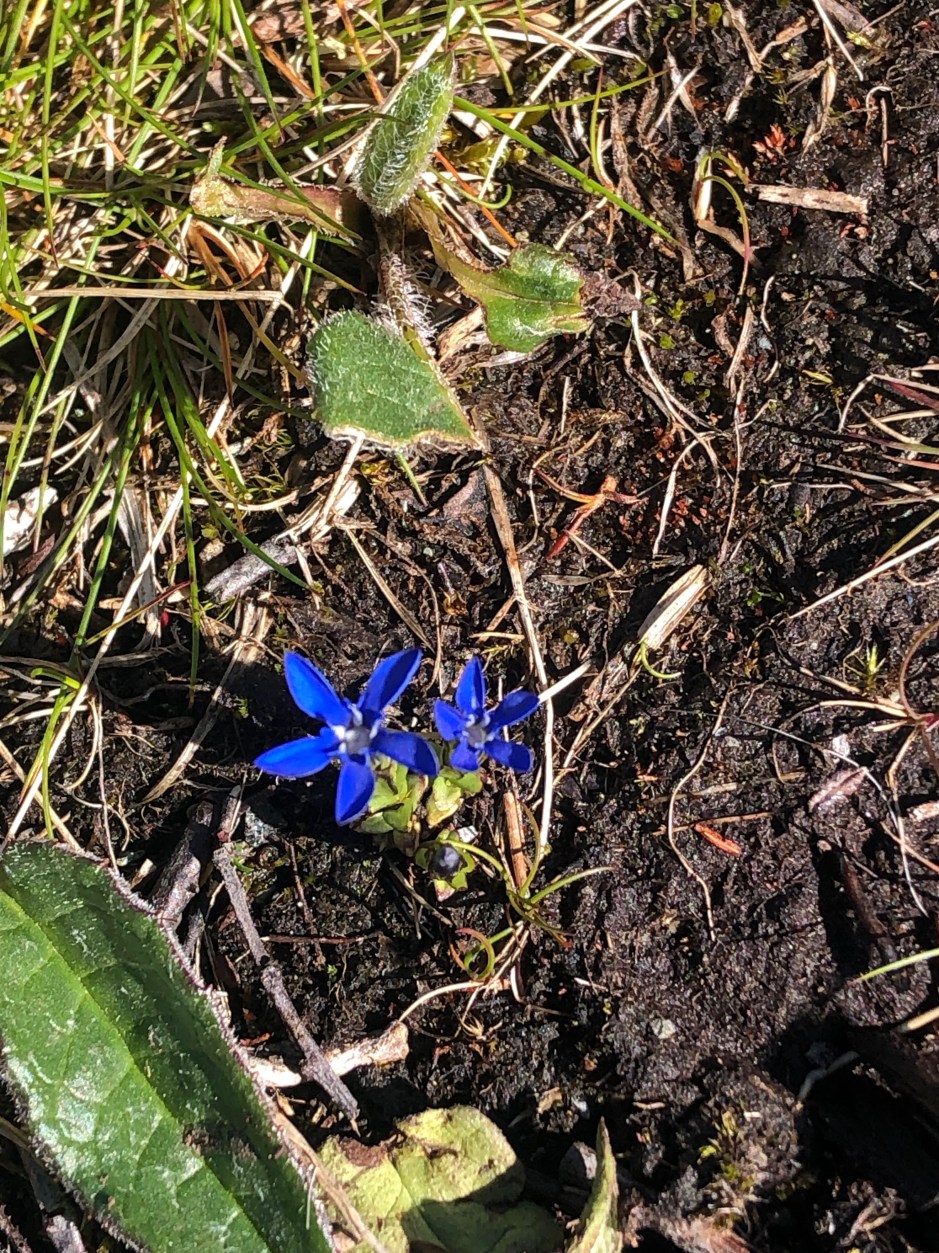
Tiny teacher big lesson

From the frozen soil
under the early Spring sunlight
you timidly sprout
Small and delicate
Yet strong and determined
Everything around you
wakes up from its Winter sleep
Cattle comes back
and walk on your path
Humans take over the trails
seeking for new heights
None of this stands on your way
as you absorb the sunrays
And one summer day
almost without warning
You bloom
Exactly where you are
Tiny delicate flower
in strong bright blue
You were born to bloom
and you fulfill your purpose
Courageous, unafected and gracious
Whether you will last long
or perish under someone's step
is not relevant for you
You absorb the light
Nurrish yourself from your surroundings
the rest, is not for you to worry about
Great teacher you are
Snow Gentian from the mountains.

Digging deeper into the layers

For long, I have been interested in understanding emotions. Their source and how to better deal with them. My interest comes from observing myself acting in unskillful ways when taken over by emotions such as frustration, deception, hurt and fear.

I have used Yoga teachings to try to better deal with my emotions, with some good results, but I am still hunted by them and I still lose control over my actions because of them. It is not because Yoga teachings are ineffective, it is, I think, because of limited understanding so far. Maybe my inability to go deeper than just seeing their source.

During the last few months, however, I have had two intense experiences that have led me to reflect on how I work with these emotions and try to figure out a better way through.

The first was a big fight with my husband earlier this year where we both contemplated (again) the solution to separate. After further discussion, however, we decided to keep trying. I decided then that I wouldn’t go into the same cycle again. I needed to get to the root of my frustration. Through reflection, a therapy session, and some reading, I realized that I haven’t been a good communicator during all these years. I have always thought I was, but I wasn’t. Out of fear to be rejected or perceived as a problem, I have often chosen the “suck it up” path in everyday small frustrations that unfortunately didn’t disappear but just accumulate until, for some reason, I reach my limit and explode for the smallest thing. Then, the focus is all on that negative emotion and explosive reaction, and a lot of time and energy is then spent regretting my behavior, apologizing, and forgetting what got me there in the first place.

Maybe because of the culture I grew up in, I have had an unconscious negative relationship with my own needs, and I have used what I have learned through the study of Yoga to confirm this attitude believing that if I practice “non-attachment”, I would at some point not need anything. What I think now, is that at the level of spiritual development I am, I need to set myself more realistic goals that can allow me to better walk the path with a more peaceful mind. Befriending my mind, understanding my needs, reflecting on which ones only I can meet, and which ones I can communicate in a constructive way to people around me.

The second experience I had this Spring was at work. A couple of weeks ago, I felt frustration escalating again towards the leadership in the school. This has happened quite often towards the end of the school year. The problem is that when I experience frustration, anger, sadness, and/or fear, I struggle to go deeper than that. All I want to is to get rid of the emotion, so I either judge myself for feeling as I do and suppress the emotion, or I find someone or something to blame for how I feel. Luckily for me, started listening to the audiobook Nonviolent Communication by Marshall Rosenberg, and I think this is going to be a game changer for me, not only to better meet the needs of the people around me but to show more compassion and understanding towards my own instead of getting lost in the overwhelm of my feelings ignoring the need behind them.

Reflecting on my marriage, my frustration often comes from feeling lonely. It can be in everyday life or when planning for a family celebration, vacation, or project. The need is to be a team. To get help. To feel that we work together towards a common goal. I have, however, been unable to communicate this because asking for help felt like nagging. Heading toward our daughter’s confirmation this Spring, my husband was much more helpful than he usually is, and I was so thankful! This made the process less tiring for me, and it felt like we were sharing the joy of celebrating our daughter instead of me running like a headless chicken all the time. I expressed my gratitude towards my husband and explained that I have been needing to feel like a team, but was unable to express it in a constructive way because I hadn’t taken the time to formulate my need in my head. Now he knows, and if he forgets, I will be able to remind him.

At work, I realized that my frustration came from a feeling of uncertainty, insecurity, and unpredictability. Because we are a small school, and we have changed principals quite a lot in the past, changes have happened in a way that sometimes has felt ad hoc and without taking into consideration the professional development of teachers. There aren’t any bad intentions from our leaders, just circumstances making things difficult for some, including me. The insecurity comes from my own self-doubt, but the uncertainty and unpredictability come from not knowing what my tasks for the next year would be and whether I would have a say on what I am asked to do or not. I realized that I have come to a point in my professional life that I don’t want to continue being subject to circumstances to that level, and then decided to change jobs. I have been offered a position where it is clear which subjects I will be teaching, with an open possibility to develop in other areas. There isn’t necessarily something “wrong” with the school I’m leaving, but there isn’t anything “wrong” with me either seeking for more predictability. That is what I need, and thus, that is what I should seek. If the school I’ve been working in for years, is unable to offer that, why keep exposing myself to the frustration described above?

As silly as it might sound to some, for me this has been an eye-opening Spring. I am not wrong about having needs, I just need to listen to them and express them in a way that helps me and does not mess up with others. In light of Yoga, I would also argue that many of these needs can be met by myself if I continue working with myself. For example, insecurity. No amount of validation from people around me will heal my insecurity if I don’t work with it inwards. Other needs like closeness when I feel lonely, help when I have too much on my plate, and a pair of ears when I need to digest an experience, are absolutely possible to communicate to my husband, friends, family, and colleagues.

Discussing my “amazing” discoveries with my husband. He asked some critical questions about my inability to express my needs better. I confessed that it often feels that they go against my wish to be flexible, kind, and reasonable. He then reminded me that any idea I have created in my head of who I am or should be is nothing more than “ego”, and it obviously stands in the way for me.