

Santosha or contentment

From contentment and benevolence of consciousness comes supreme happiness’  Iyengar, B. K. S.. Light on the Yoga Sutras of Patanjali

Contentment is an important ingredient in the life of a yoga practitioner. In my understanding, we need to keep it in mind at all times during our everyday life in order to channel our energy in the right direction and cultivate a calmer state of mind but it is also something I can notice developing on its own inside me as I walk on the path of Yoga.

The what, the how and the why of contentment we try to generate.

Firs of all, what do I understand by contentment? I tried to find a translation in Spanish for one of my students but all I could find was something that translated back to English is “happy”. In my opinion, it is more nuanced than that. Being content is not necessarily being happy. Being content is more like being ‘okay’ no matter what. Noah Rasheta from Secular Buddhism defines it as ‘okayness’. This means that no matter what life is serving you today, you try to stay balanced. Why? To save energy mainly. Mental energy. If you don’t waste energy in getting all worked up in everything that doesn’t go your way, you can then direct your efforts towards dealing with the situation more appropriately. You avoid reacting out of impulse and you start acting more skilfully.

Contentment is one of the four niyamas in Patanjali’s Ashtanga Yoga. We are encouraged to practice it together with cleanliness of body and mind, sustained courageous practice, self-study and surrender to the supreme Self or God.

Being content means that when things go the way we wish them to go, we enjoy them and let go when we have to let go of them, and when things don’t go as we want, we focus on what can be done and what can be learned instead of getting lost in negativity. Not because negativity is ‘wrong’ but because most of the time, it won’t lead us towards any constructive action.

As one of my students put it today, if you get lost in negativity, you can’t get the whole picture of what is happening around you which may also include positive things. I loved this reflection!

Another way of cultivating contentment is to be tankful for what we have or for what does go as we wish it to go. It might sound difficult when we are in the middle of a crisis, but if you think about it, we can always be thankful for something: for being strong enough to endure this difficult situation, for the support we receive from others, for the food we get, the clothes we wear or the bed we sleep in.

How does contentment start growing from the inside?

When we constantly practice non-attachment to the results of our actions and at the same time put our best intentions into them.

Detachment brings discernment: seeing each and every thing or being as it is, in its purity, without bias or self-interest. Iyengar, B. K. S.. Light on the Yoga Sutras of Patanjali (Kindle Locations 774-775). HarperCollins Publishers.

It requires a lot of practice, but when we manage, the feeling is of pure freedom. When you can tell yourself: I did my part, the rest is out of my hands and you really let go. If the result is the desired one, we are thankful, if not, we try to find the lesson in it, and move on. Done. No need to dwell on it. Freedom and contentment.

When we learn to trust. Trust in ourself, trust in the journey, trust in our guide(s), and/or trust in the Universe/God or however you want to call it. You stand up, brush the dust, and keep walking.

When we understand that our inner peace is independent of external stimuli. When we understand that what lies at the core of our being is independent and unaffected by anything that is external to us.

But the individual who truly loves the soul and is fully satisfied with the soul and finds utter contentment in the soul alone, for him no duty exists.’ Yogananda, Paramahansa. God Talks with Arjuna: The Bhagavad Gita Ch11 v17

Allow

Allow, flow with life and take time to observe what is happening. Avoid labeling every situation as good or bad. When we refrain from liking/disliking a situation, we let go and can act more skilfully. We neither run away nor cling to what is agreeable. 

Allow yourself to experience feelings and emotions. Allow yourself to experience what we call difficult emotions. Do not suppress, but do not feed into them. Be curious. Where does frustration, anger or sadness come from? Can you find the source inside you? Is it because of attachment? Is it because of expectations? Can you let go? If you are not ready to let go, do not push it. Just observe when they come, and as you would do with someone you care fondly of, be kind towards yourself, show compassion and understanding and tell yourself that slowly, little by little you will be able to let go. You can start by being aware.

Allow people to walk in their path, show the same curiosity, compassion and understanding, but do not allow their actions to disturb your inner peace. Remember that we all seek the same in different ways. That we all make decisions out of what we perceive and expect. 

Allow, flow and see how a lot of energy is saved, the energy you can use to live a clear and more creative life.

Be patient, it takes practice and time.

‘Behind all our efforts, our basic motive is to find happiness and thus to find peace. All our actions are for that good. We are all working toward that happiness. Even all these wars, fights and competition are ways people look for happiness. Even when people steal things, they think they are going to be happy by stealing. So the ultimate motive behind all our actions is to find that joy and peace.’ Sri Swami Satchidananda in Living Gita

What’s up with Fridays? or Friday, My New Teacher

I am trying to live my life following a simple yet sometimes difficult to follow principle: put my energy and creativity to do my part in everything I undertake and let go of the expectation of the result being as I wish it to be. This is a very nice way to focus my mind and energy in doing as good as I can and not wasting it in worrying about the outcome or getting all worked up by perceived failure.

This said, when things do go well or even better than I could imagine them to go, it kind of becomes addictive so when something doesn’t go as smoothly and well as the rest, the fall feels harder. This is quite funny when I think about it, but not that funny when I’m in the middle of it .

The last couple of weeks have been what I would call ‘good weeks’. I feel motivated, inspired and creative at work. My colleagues and I had been working on a couple of projects for our students, and they seem to have worked well. Students had fun, and we believe they also learned something.

I have been offered to teach two groups of ‘corporate yoga’ at a company where I have worked before and people seem to enjoy the classes. I have many ideas for these groups and I am so happy and grateful to get this opportunity.

I will start teaching two other evening yoga classes at a new place where I have been given the freedom to decide what to teach and how to teach it. I also have many ideas for these two classes, and I am super happy that the owners of this place asked me to join their team.

My kids and husband are doing well, everything is running more or less smoothly at home with daily routines, kids’ after school activities, and so on.

Happy days but busy days. So the past two weeks, when Friday comes, I kind of expect it to go as smoothly as the rest of the week only even better because IT IS FRIDAY. Finally the day to ‘relax’ has come.

To my big surprise and frustration, both Fridays have been the most challenging days in both weeks. Just when I am starting to let down my guard, one by one small challenges, like obstacles in a race, start appearing and I notice how little patience I have to deal with them. I experience a combination of frustration and amusement watching myself become more and more angry because the day of the week that should be the ‘best day’, turns out to be the least relaxing.

What happened? Nothing big actually, but combined with my expectations on how things should be, it can feel quite big.

Last week, I struggled to keep my cool when the lady at the drugstore behaved in a way that I perceived as condescending. The frustration was not just because of how I felt I was being treated, it was combined with frustration against the health system because I have been trying to get in contact with one of the specialists that see our daughter to renew a prescription and it felt like Mission Impossible. Then the pharmacist, who of course doesn’t know this, wasn’t being helpful. I was tired after a ‘good’ but busy week, and I noticed myself getting angrier and angrier. My dad has a say ‘el que se enoja pierde‘ , ‘the one who gets angry looses’ (I’m very bad at translating these proverbs, I hope you get the point). So, I lost it, and I just had to get out of the drugstore to not get even more angry and say something that I would regret afterwards. Did the problem get fixed? Nope. So I kind of lost.

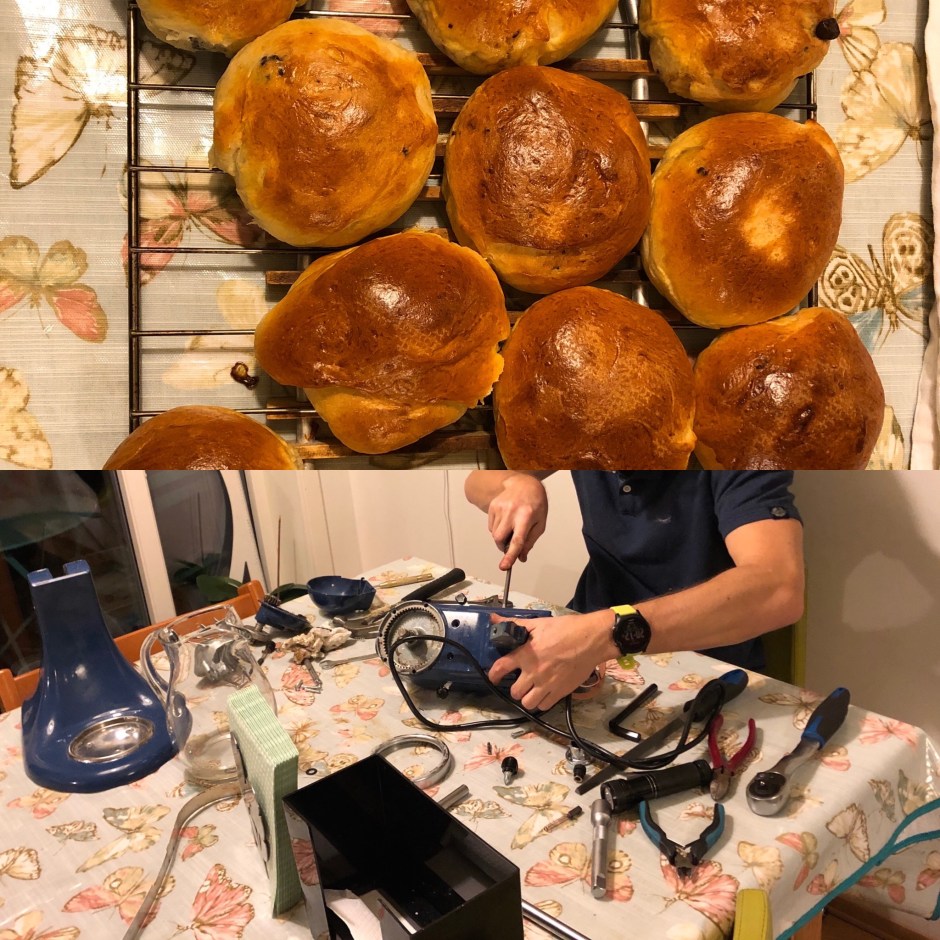
This week, the same story repeated itself but instead of a tired pharmacist, I met my tired ten year old Kitchen Aid. I had the ambition of making bread buns for the yearly voluntary work to get the neighbourhood ready for winter tomorrow morning. I wanted to make two batches. It was going to be a ‘cozy moment’ between my oldest daughter and I. Half way through the process of kneading the first dough, the Kitchen Aid said ‘bye bye’ and stopped working, and not only that, I couldn’t get the bowl out of its base to take the dough out. After five minutes of ‘patiently’ wrestling with the machine, my daughter standing by my side looking more and more worried, I just had to stop and observe myself for a minute. The thing is that I wasn’t only frustrated because the machine stopped working, I had already started making many connections in my brain. First, ‘what am I going to do without my Kitchen Aid?’ Followed by, ‘some weeks ago the electric whisk died, then the blender, and now the Kitchen Aid? What is wrong with our house? What am I going to do? I don’t want to knead two doughs tonight. It is going to get late and we won’t have time to watch that series we like to watch all together?, Our youngest daughter is going to be so disappointed?’ , and so on.

I took a deep breath, and went to get a rubber hammer from the basement to ‘gently’ encourage the bowl to let go of the base. My daughter’s eyes were as big as plates but I managed. And we continued our ‘cozy’ evening with me getting some extra arm strength as a bonus.

To be honest, now that I think about it. I am happy these kitchen appliances have been one by one saying goodbye. My kitchen counter has more space, and I can still cook a decent meal without them. I believe in trying to repair things when possible, but these three were old and cranky, so we can say goodbye with good conscience. Plus, my husband had a good time dismantling the whole thing.

I take with me some reflections for next week, and hopefully when Friday comes, I will be ready for its challenges. One: keep my expectations in check to avoid unnecessary waste of energy in frustrations. Two: make sure I take time to rest and do nothing from time to time from Monday through Thursday so when Friday comes, I still have energy to deal with whatever is. Three: keep practicing detachment, especially when it comes to material things. I have so much more than I really need, it is maybe only a gift to be encouraged to live in a simpler way.

Luckily, the buns turned out quite good. My kitchen looks tidier, and I can now go to bed with a smile in my face.

Not perfect but certainly unique

I’ve been living outside my country of birth for over twenty years now. I first moved to France when I was 19 years old, and then to Norway when I was 23. It was especially in Norway that I experienced several times being hesitant between what I felt was the natural thing to do, and what I observed the locals did (or didn’t do). During years, it became a sort of internal battle, and I must confess that my inner impulses often lost because of the fear to not fit in, to be seen as strange (who’s ‘normal’ anyway?). It is as if moving to another country suddenly confirmed all my insecurities and created new ones.

In recent conversations with some other ‘foreigners’, I have discovered that many experience the same. A yoga student was telling me the other day that she dislikes the fact that there is no culture of feedback in the company where she works or at least feedback she feels she can grow professionally from. She would appreciate constructive feedback to improve, but there might be this fear of ‘hurting’ people’s feelings by pointing at what could be better. When I asked why she didn’t bring this up, she seemed unsure. I completely understand her because I can relate to the experience. More often than not, I also choose to go with the flow, but why? In my case, I am afraid of my idea being rejected but if you think about it, if that is the worse that can happen, I might survive no?

A colleague was sharing a similar story. He volunteers as a coach at his kid’s sports club. Here in Norway, it is traditionally parents who organise and coach kids in many sports activities after school. My colleague had observed how the behaviour of the kids sometimes comes in the way for better opportunities for them to learn, and he had some ideas of how to improve this but again, he felt pretty unsure about bringing this up with the other parents. ‘This is maybe the way it is done in Norway’, he said. I think that the sports club is lucky to have him among the volunteering parents, and they would benefit from hearing his ideas, but it seems like he wasn’t completely agreeing with me. And I get it. I know it is easy for me to sit there and listen and want to push him to act when I haven’t done it myself in so many other situations. Of course, this doesn’t only happen with foreigners, it happens to many everywhere.

Coincidentally, I had been reading about svadharma while preparing a workshop about Karma Yoga this week, so I have been thinking a lot about how important it is to be courageous enough to see our uniqueness as an asset, and use it more often to encourage small changes around us…or at least try. Somehow, many of us believe that there is one right way to do things and many other wrong ways. Or, if everybody is doing it the same way, and I see another way, it must be because I am wrong.

It is well-known that the best way to help someone is to focus on his/her qualities, and use them to help him/her grow and develop. Why do we forget to do the same with ourselves? Do you know what you are good at? What comes naturally for you? What do you do that makes you feel a sense of purpose, a sense of meaning? If not, don’t panic, you have it (everybody has it), but it is for some reason hidden from you. Maybe you have been spending too much time putting your attention ‘out there’? Comparing yourself with others? Following other’s path without noticing that it is not yours? Or maybe you have been too busy criticising yourself? Focusing on your less good sides? On your ‘darker’ sides? Have you ever thought about the fact that in order to be light, we need darkness? That we need two sides for a coin to be a coin? So you too have very good and less good aspects in your personality. It is good to try to improve the less good ones, but it is not good that they take all your attention and cloud your good sides.

Here are some challenges for you (and for me). In the weeks to come, start every morning by writing down three things that you see as qualities in you. Don’t allow your mind to play you tricks like saying ‘this is silly’, or that you don’t have any unique qualities, or that yes, maybe but so and so are even better than you. Then, before you go to bed, think about situations during the day where you used these qualities for the benefit of the whole. How did that make you feel? Do you think you need to use them more? Last but not least, is there something you’ve been wanting to suggest at work, in your neighbourhood, at home, or wherever but you haven’t dared? Maybe now is the time! Try, and if your idea isn’t accepted, at least you won’t go around for the rest of your life wondering what would have happened if you had dared to try.

Karma Yoga

In the Yoga tradition, there are different paths, all with the same end goal: to clear the mind so we can see our true potential. Karma Yoga is one of my favourite paths because it is for the practical life. Through the practice of Karma Yoga, you can continue living the life you are living and still live a spiritual life. It is all about changing the attitude you bring to your actions. I sincerely believe that if we all were familiar with the basic principles of Karma Yoga and tried to follow them in our everyday life not only we would be able live more peacefully and relaxed, but we would also make this world a better place.

To begin with, we need to look at the importance of the intention behind our actions. In order for an action to be liberating, it needs to come from a space of clarity as opposed to a state of selfish desire or neediness.

What Karma Yoga is trying to teach us is that since everything we need is already within us, we don’t need to seek for it in the external world. Therefore, we can detach from the fruits of our actions. We are responsible for the intention behind our action and the action in itself but we are not to worry about the results because they are out of our control. We all have experienced doing something for someone with the best of intentions to then be surprised and maybe even frustrated by the reaction of that person. For example, you make a nice dinner for your family putting your heart into it, spending time planning and preparing but nobody likes it. Your kids even make noises of disgust while eating. A common reaction would be to get upset, right? You put all this effort for ‘nothing’. But, is it really for ‘nothing’? You had a clear and pure intention, you did your best, whether your family likes or not the dinner is out of your hands. You can either spend time and energy getting angry and frustrated, or you just decide that either they need to be exposed to this dish several times to like it (do you know about the 10 times rule?), or you won’t make this dish anymore. That’s it. No drama, no unnecessary use of your energy.

It is important at this point to say that it is not about suppressing your emotional reactions to situations, it is about taking time to observe them and learn something about yourself. You are ‘allowed’ to get frustrated or angry, but you can try not to react to this in a way that is draining both for you and those around you. What was the real intention behind your action? Was it to do something nice for your family (in the dinner example), or was it more about wanting to get some sort of recognition? If it is the latter, ask yourself, do you really need anyone to tell you that you are a good cook? Can you acknowledge that yourself? If you really need the recognition, then say it clearly, ‘I made this dinner with the best intentions and I would appreciate some recognition, even if you didn’t like it’. You are then being very clear both to yourself and those around you.

To summarise: Intention and action are your responsibility. The results are out of your hands and therefore you would benefit from detaching from them to avoid unnecessary worry and/or frustration.

Another important aspect in the practice of Karma Yoga is the concept of svadharma, or personal duty. Swami Satchidananda has a good explanation for this:

“What you’re truly called to do is your dharma. It fits your aptitude, your capabilities and your natural inclination[…] No two snowflakes are exactly the same. As such, you are also unique, you have been created unique with certain abilities that no other person can do. That’s your svadharma, your individual duty[…] Find out what your svadharma is. Ask yourself, how do I feel when doing certain things? Does something come easily? Is it natural for me or am I trying to imitate somebody? But remember, that svadharma is different just an action based on a selfish interest. Svadharma is something righteous. The word “dharma” always implies the benefit of others.” From Sri Swami Satchinanda’s commentary on the Bhagavad Gita ch.3 v.33, 34, 35

This is such an empowering concept! We all are born with a set of qualities that makes us unique, and our duty is to use them in every action we take for the benefit of the whole. This is very important, you don’t need to resign your job, or neglect yourself and/or your family to go help others, you can contribute to the well-being of others by doing what you already do with the intention of doing what is most skilful for you and those around you. You can also stop comparing yourself with others or trying to imitate others. There is nothing wrong with trying to improve yourself, but the only one you need to compare yourself with is yourself. You can ask yourself, am I a better version of myself today than last year? How does this make me feel and those around me? If the answer is more peaceful, you are then in the right direction.

Connected to the concept of clear intention is the importance of asking yourself ‘why do I do what I do?’. This can help you get to know yourself better and decide: 1) What am I doing just to do and I can let go of? Make a list of your priorities, if that list is very long, you might need to consider shortening it. 2) What am I doing with a ‘hidden agenda’ that I can stop doing or do with a “clear agenda”? What I mean by ‘hidden agenda’ is that sometimes we do things believing that we want to benefit others, when in reality we are looking for recognition. There is nothing wrong with wanting recognition, but in order to achieve a real state of peace of mind, in the yoga tradition, we are encouraged to start looking inwards for our value. All we find in the external world is transient, and therefore will never fulfil our needs completely. 3) What am I doing out of obligation?

If you find out that you do things out of obligation, can you change the mindset? Can you do things out of love? With your heart put in action? One example is parenting and spending time with our kids. Some parents experience certain aspects of parenting as an obligation, making this task more heavy and energy draining than it needs to be. If you rather see the whole picture and realise that you do everything out of love to your children, out of love to all children, the task will be less heavy and you will feel better. If you cannot find the joy in it, can you drop it? We sometimes feel that we are ‘obligated’ to do things that we really aren’t obligated to do.

All or some of these concepts might sound too difficult to live up to for you right now, and that is ok. You don’t need to apply everything at the same time, reflect on what is achievable for you. It might be enough to observe yourself in action and to note down where you meet distress and stress, and reflect on whether any of the described concepts would help you unknot some knots. Remember that one of the most important aspects in all yoga paths is practice. You need to practice, practice and practice more. Sometimes, you will feel the freedom, love and bliss that right action bring, sometimes you will feel that you keep giving with ‘nothing in return’. That is normal, but the more you advance in the path of yoga, the easier it gets, and I honestly can say that changes do start happening. It works almost like magic but you need patience and resilience and good guidance. Good luck!