
Reflecting but not Writing or How Time Flies!

It’s been some weeks since I last wrote in here. I can’t believe we are approaching the end of February already! Ever since school started after the Christmas break, it feels like every week I’m having ‘exceptionally’ busy days at work. I don’t complain, I’m back to a full-time position, and I must say that I enjoy being a contact teacher. It gives an extra sense of purpose. In addition, I signed up for an online eight week course with my Yoga teacher, Prasad Rangnekar, to study Patanjali’s Yoga Sutras. This helps me keep searching for the balance between practicality and spirituality.

From what I know so far about Yoga, Raja Yoga, or Dhyana Yoga as it is called in the Gita, is the path that resonates the most with me. I do apply the principles of Karma Yoga to my life, and I feel inspired by the devotion of Bhakti Yogis, but learning to better understand my mind and how to work with it to cultivate a calmer inner state is motivating and fascinating to me. I also notice that it helps me to improve my interactions with people since I recognise myself in their behaviour. Although we are different and we behave differently, it seems to me (and according to Raja Yoga) that the root of your behaviour is always the same.

One thing that has been a lot in my mind during the last few weeks is my wish to stay calm, to keep a somewhat stable inner peace. For this, I keep reminding myself to do my part and avoid wasting energy on external factors that are out of my control. Every time I catch myself judging or resisting a situation, I take a deep breath and ask myself what I can do to get through it. Is it necessary to be assertive, or should I just play my part and let go of my need of ‘fixing’ everything? Is the fact that I am adding my judgement to the situation or behaviour making it more stressful for me? This was actually one of my New Year’s resolutions: ‘less judgement’. I must say that it is difficult, I have an opinion about everything! I either like or dislike. But reminding me of letting go of the judgement and just doing my part allows me to be more clear about what my role is and where the part that is out of my hands starts. It requires a lot of practice, but it is liberating when I remember.

Knowing that January was going to be busy, I have made it a golden rule to prioritise sleep. I don’t go to bed later than ten thirty on week days. When I sleep well and enough, my mind is clearer and I am much more in control of my emotions. I think this is a big present for myself and those around me. My teacher said it the other day and I totally agree, contentment starts with a good night sleep.

In order to sleep well, it is important to balance the day by trying to live through the principle of moderation. Yes, I have a lot of work, but there are certain things that are less urgent than others. I am learning to prioritise better so even if I have been having longer days at work, I can still dedicate time to my kids when I get home, do some physical activity every day and have some time to do what I enjoy. The key is to adjust everything to the time and resources I have. For example, instead of aiming to running or go skiing in weekdays, I walk or ride my bike to work to get some exercise. I could also run, but I have a heavy backpack and I don’t want to run with it.

It might sound like mission impossible, but it isn’t. It just requires rude honesty and the willingness to let go of the need to do everything perfectly and instantly. Some things can wait. Some things can be delegated (hey, my husband can also cook dinner!) Some things can stay undone and the world will still turn.

Something that has also helped me a lot lately is to accept that all I can do at all times is try my best with the best intention. It sounds silly, but when I manage to really live up to this principle, I relax because I know that if I make a mistake, or if someone perceive one of my actions in a negative way, I can just say sorry and try something different next time. No need to be defensive, no need to be afraid because I know that I did what I could given the circumstances. That puts a lot of pressure off my shoulders.

Lastly, I have been thinking a lot about the fact that we sometimes mess up. Sometimes we’re not feeling great. Sometimes we struggle, and that is okay too. No need to add distress to the difficult situations. All we can do is accept the bad taste of the situation, try our best and remember that ‘the only way out is through’ (Prasad). There is always something to learn out of every situation, and often, the most challenging ones are the most enriching ones when it comes to personal growth.

And gratitude. Gratitude to be able to be part of the whole. Gratitude to be able to observe, reflect and hopefully learn. Gratitude to the beautiful people that cross my path, inspire me and teach me lessons. Gratitude to have all my basic needs met and more.
On the screening power of screens

Last week, I met a boy from fourth grade when I was on my way to get my bike to ride home after work. He sat outside on a bench in the Norwegian Winter weather. I asked why we was sitting there alone, and he replied he was waiting for his dad to pick him up. I asked if he was ok, yes, he said, I have my mobile. He was playing some game on his telephone.

On my ride home, I felt sorry for him, sitting in the cold weather, waiting for his dad, and I remembered how, when I was in primary school, also had sometimes to wait to be picked me up. I went to a private school that was far away from our place, so there was no option to walk. I remember feeling a mixture between boredom and sometimes fright of never being picked up. As an adult, I know this is unreasonable, but as a kid, it did seem plausible. The only difference is that I grew up in the Caribbean, so at least, I wasn’t freezing…

…wait a minute, is it the only difference? What else do you think was quite different? I didn’t have an electric device to distract me from my emotions.

Lately, I am reflecting a lot about the impact all these screens must have in kids and adults, and I must confess that it worries me. I wonder how, the fact that we can be constantly entertained by these devices affects our emotional health.

It is well known that humans don’t like to experience what we see as negative emotions, and as parents we want to protect our children from feeling emotionally distressed, so we do whatever we can to change their moods. Access to an electric device often seems like a good tool. If a child is bored in the car, he can play games on the telephone. Or if she doesn’t like to sit still at a restaurant, she can watch videos on YouTube while the food is served. I must confess that I enjoy the peace and quiet TV brings on weekend mornings too. My kids watch TV while I can enjoy my coffee in the other room without being disturbed.

What I wonder about is if not the constant access to screens gradually puts a veil in people’s ability to see their own emotions. We hide our discomfort, our distress by keeping our minds busy, and we loose contact with ourselves. I also wonder if this loss of inner contact can result in loss of empathy and the ability to see other people’s emotions.

One could argue that electric devices are not alone on having the role of distractors, some read to flee from reality or to relax, others play an instrument, or go for a run, but I would argue that all these activities and other that we use to distract ourselves, require more from us than pure entertainment coming out from a screen.

I know that there are many different factors that influence the mental and emotional health of a person, and I guess that if a child that has free access to electric devices grows up in an otherwise open family where any emotion is welcomed and communication is positive, what I write about must probably won’t happen.

Maybe that is the key, maybe that is what concerns me more than the screens, the fact that well-meant adults want to ‘protect’ children from challenging emotions instead of allowing them to feel and help them develop tools to cope, to learn from them. I think one of the biggest gifts we can give our children is to know that they can overcome any difficult situation by learning to go through the distress and pain. To find strength inside them and to ask for support when they need it. Sometimes we experience pain and distress because of our own perceptions, sometimes it is caused by our interactions with others, sometimes it is the result of unforeseen and uncontrollable life-situations. Maybe we can also teach our children to see the difference between them and encourage them to see how they can deal with them.

Everyday warrior

What are the characteristics of a warrior? How would you define yourself as an everyday warrior?

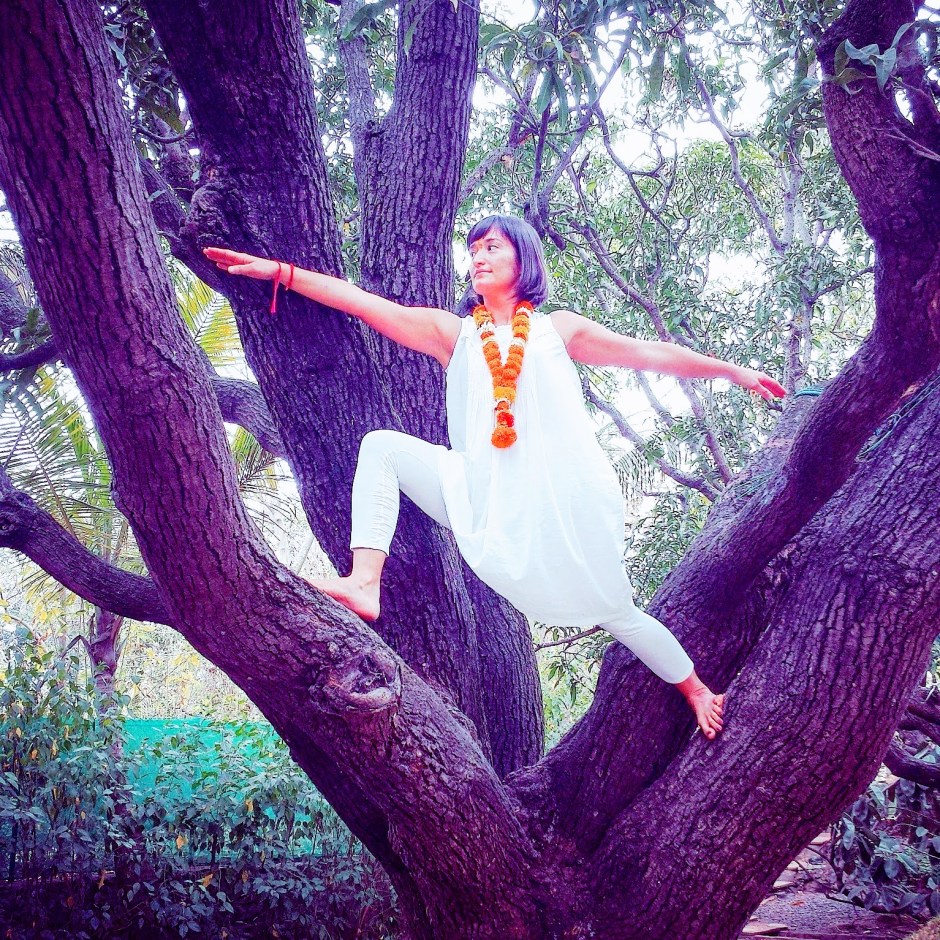
These questions came to my mind when I was planing an asana class where the main poses were the different variations of Virabhadrasana or Warrior pose.

In the yoga tradition, and as far as I know, the most famous warrior is Arjuna who is one of the main characters in the Bhagavad Gita. We meet him right before the battle of his life, the battle of Kurukshetra. Luckily for him, he has Sri Krishna as his charioteer and closest friend.

What I like about the Gita is that although it is known that Arjuna is a great warrior, the first we learn about him is that he is in despair. He is invaded by doubt and maybe even fear and he doesn’t know if he wants to fight this battle or not. What? A warrior that shows weakness right before the battle of his life? How come? How can we relate to that?

Arjuna teaches us that a warrior isn’t always on top of everything. A warrior experiences moments of doubt, of despair and fear, but what makes Arjuna an exceptional warrior is that he acknowledges these feelings and seeks for advice from Krishna.

Krishna then has a long conversation with him where he seeks to encourage Arjuna to make his own decision, but this decision should not be based in fear and distress. Arjuna needs to calm his emotions and see the whole picture. He needs to look inwards and find out what his duty is regardless of the outcome of the battle. Running away is most probably not the best solution because the issues that led to the battle will continue hunting Arjuna and his people.

I believe, there are many ways to interpret this story and make parallells with our lives, but what I have been reflecting about lately is the importance of doing what we can with what we have, with the best of intentions, and allow the result to be as it needs to be. Sometimes, we are put in situations where we feel helpless, where we don’t know what to do. It is wise to pause, calm down, and then proceed. Sometimes, we make the wrong choices or we make mistakes, but what makes us an everyday warrior is that we learn and move forward.

We don’t have all the answers, and that is perfectly fine. If we had them, we most probably wouldn’t be here…

Christmas 2020

For many years, taking care of the environment for me meant not to litter, be kind to animals and be respectful towards plants and other living beings. I rarely reflected about the impact of my lifestyle on the environment until maybe five years ago, maybe a bit longer.

I must confess that I sometimes find it as mission impossible to live a more environmentally friendly life. Just when I replace a bad habit with what I believe is a better habit, I discover I have other hundred bad habits I need to change. It seems like the world we live in is made to make us fail in our attempt to take care of the environment and all living beings in the planet – not just plants and animals but also other human beings.

So, how have I contributed this Christmas season? I don’t see my performance as successful, I know we can do better, but at least we are trying. Here are some of the things we did, and some of the things we learned this year:

Presents

I have always liked to give Christmas presents that I think will mean something to the receiver. Either something I know they need, or like or might find amusing but lets face it, most of the people I know don’t need anything. They are completely capable of getting what they need and want whenever they feel like. So, we followed some advice I found in ‘fremtiden i våre hender’.

  1. Give edible gifts. We gave edible presents to some of the people we really wanted to give a present to. Either bought from local producers or made by ourselves (cookies). I bought also gift cards to local small businesses to some.
  2. Give experiences. We gave our son a gift card to a place he likes to go with his friend, and he was very happy to find out that he can spend the amount inviting other friends.
  3. Give used. My daughters have been wanting to have bell bottoms for a while, so I bought them used. At their age, most kids barely wear something before growing out of it. I found some online, and got them delivered by the postal service. My husband wanted a new jacket, I also bought it used from a family who ‘had so many jackets’ that they never used most of them. So his jacket was as new, just without the price tag.
  4. Make the gifts yourself. We bought some white tea cups at a second hand shop and ceramic markers. The girls really enjoyed decorating the cups for their uncle, aunt and cousins. We also crocheted a couple of stuffed animals for friends. It was fun for my youngest who had never had the patience to finish a crochet project, and for me who had never made a bigger one before. We had yarn at home, and just bought some more when we were running out of colours.

Food

  1. Simplify a little. We enjoy good food, but at times, it can be too much. So, we try to be more moderate with the amount of food we buy. We planed for Christmas Eve and the days following towards New Year’s Eve and for New Year’s Eve too. We try to have some special dinners and some simpler dinners as well, and have some days with leftovers so we don’t throw anything away.
  2. Choose vegetarian dishes wisely. I became a vegetarian two years ago, so we also cook some vegetarian dishes during the Holidays. Some days, the rest of the family eat the typical meat dishes while I eat an alternative. Other days, we all eat vegetarian. One thing we have discovered during the last two Christmases is that there is really no point on making dishes that are supposed to look like Christmas dishes. They are complicated and mediocrely tasty. It is much better to choose some of our favourite vegetarian dishes, especially those we know from Indian cuisine.
  3. How much sugar do you really need? We are trying to limit the sweet treats to one a day. We made dessert for Christmas Eve and we had the leftovers for Christmas Day. We baked some cookies that we have shared with friends, and we bought some chocolate for some other days.
  4. Buy locally as much as possible. My husband really likes eating good food during the Holidays, and he took the job this year to look for local farmers and producers and bought all from potatoes to meat and strawberry coulis.

Other traditions

  1. Advent calendar. Here in Norway, the Advent calendar is a big thing for kids. Having three kids, it makes it expensive and not so environmentally friendly to put a gift for everyone each day. One of our kids needs to have a stricter diet, so giving them chocolate every day is not an option either. Therefore, we vary between small presents (mainly things they need like socks, gloves, soap, etc), activities (bake gingerbread cookies, decorate the house, watch a Christmas movie, etc), and the occasional chocolate treat especially before the break when we have busy days and it is not possible to have an activity for the evening where everyone can participate.
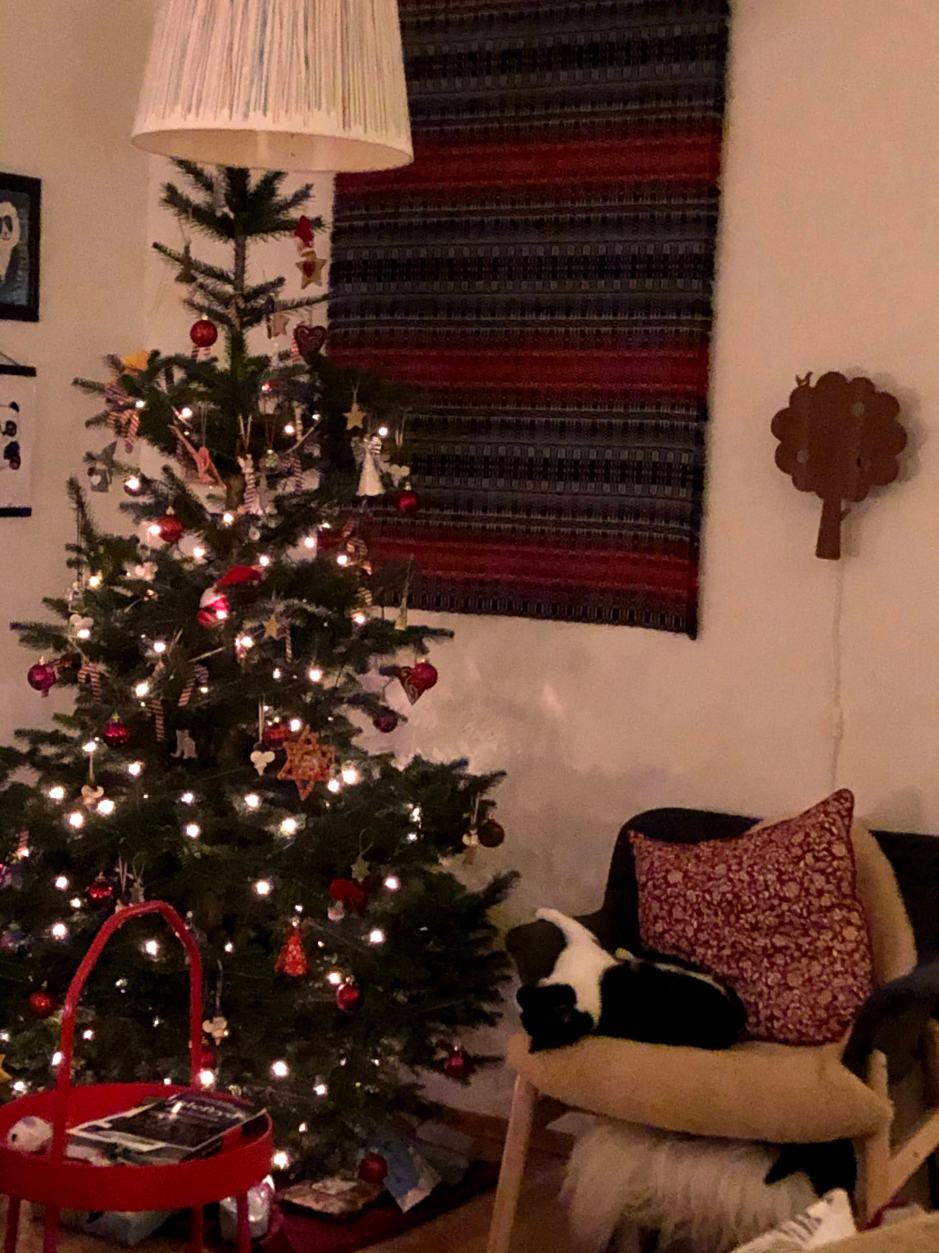
  2. Christmas tree. I checked online what was more environmentally friendly, and apparently, getting a real tree is better than plastic, just by a small margin. It needs however to be a local tree from a conscious farmer. Therefore, this year, I took the kids to a farm where you can cut your own tree. It was the first time we did it, and my three kids thought it was fun but it made me doubt the whole tradition. While we were there, it felt wrong to kill a tree to put it in our living room for some days and then turn it into compost. I asked the farmer how many years it takes to grow a tree like the one we cut, ten years he said. Ten years!! Almost the same age as my youngest. I know we also ‘kill’ carrots and potatoes, but they are necessary for our survival. A Christmas tree isn’t. So, next year, we have to come up with an alternative. The same farmer sells trees in a pot, maybe that could be an option? My husband suggested we plant one in the back yard, but the kids can’t accept the idea of not having a tree inside the house for Christmas…Maybe plastic is not that bad anyway? We’ll see what we do.

This makes me think about the importance of once in a while taking the time to reflect on the traditions we have. Ask ourselves why we have them and how they affect the environment and other people. Some of them can be replaced by other less harmful traditions, some of them we can let go of.

We have definitely a long way to go to become a more environmentally friendly family, but I am happy we are aware and trying.

The song in my head

I constantly go around with a song in my head. Luckily, it isn’t always the same song but don’t ask me how my mind decides to change it. It just happens. I don’t seem to have any control over it. You might have noticed that not only songs seem to appear in our minds uncontrollably. Many (if not most) of our thoughts are like that.

In February, I went to a ten day retreat with my Yoga teacher in Munnar, India to learn more about meditation. We practiced silence during two of the days during our stay, and what I noticed this time is that many thoughts kept coming back like a playlist on loop. Even thoughts about events in my life that I felt I was over with. I think this happened because my mind was desperately trying to find things to cling to. I sometimes suspect my mind for trying to torture me emotionally…

Luckily for me, I am have been practicing japa since I started studying Yoga five years ago and it helped me to calm my mind. Japa is the repetition of a mantra, and it is used as a technique in the Yoga tradition. We can read about it in Patanjali’s Yoga Sutras:

1.27-29 The word expressive of Isvara is the mystic sound OM. To repeat it with reflection upon its meaning is an aid. From this practice all the obstacles disappear and simultaneously dawns knowledge of the inner Self.

The mantra mentioned in the Yoga Sutras is the word OM which is known by many people. The beauty of it is that it is easy to remember, it is powerful and it is very soothing to repeat either aloud or in your head. I repeat OM as part of my meditation practice, but it can also be repeated mentally whenever and wherever.

In the Yoga tradition there are many mantras. Sri Swami Satchidananda mentions Japa Yoga in his commentary of these sutras, which I think is the repetition of mantras as a technique to calm the mind and come closer to the True Self.

It is also possible to have a personal mantra (preferably made with the help of a teacher) often repeated as some sort of antidote against limiting thoughts (i.e. ‘I am safe and secure’ if you know you are the anxious type, or ‘I am enough’ if you are constantly torturing yourself with thoughts of self-doubt, ‘I learn and I grow’ if you keep putting yourself down whenever you make a mistake). Usually, one has one mantra and sticks with it for a long period or even a lifetime. It is not advisable to change mantra as we change socks because for it to make a change in our mindset, it needs to be repeated constantly over a long period of time. That is called japa.

So, when, where and why do japa? Whenever and wherever! You can decide to start from the moment you open your eyes in the morning and continue whenever you remember. Most probably, your mind will keep taking over, but when you notice, you go back to your japa to still the busy mind. It is a very good ‘activity’ to have when waiting in line, or at the waiting room before an appointment, while sitting on the bus, while going for a walk, etc. Once repeating your mantra becomes a habit, it can be powerful tool when you are feeling mentally or emotionally distressed. I remember a friend of mine told me she used her mantra when she was lying on the operation table right before surgery, and it helped her feel safe. I use mine when I wake up in the middle of the night and notice my mind is all over the place. Most of the time, it helps me fall asleep again quite fast.

Note that Patanjali tells us that by doing our japa, ‘obstacles disappear’. The obstacles in question are our own mental obstacles. The practice of japa is to overcome our limiting thoughts. Either rumination, regret, worry or limiting thoughts about ourselves. The noice in our head that doesn’t help us.

Ask yourself, how is your self-talk? What do you usually think about yourself? Do you usually feed into your strengths and qualities or do you ruminate on your shortcomings. When you make a mistake, do you show self-compassion or do you drag yourself down through your critical inner voice? Unfortunately, most people have quite nasty self-talk. Whenever you catch yourself putting yourself down stop, take a deep breath, show yourself some understanding and either replace the thought with a positive one, or do your japa. It doesn’t need to be ‘relevant’. You are trying to train your brain to stop limiting yourself.

It doesn’t mean that we don’t spend time reflecting on what we can do better next time, but it means that we talk to ourselves as we would like a good friend would talk to us. You want to have constructive self-talk, not destructive.