Busy bee? Not today

I need to start creating moments during the day to take a pause. It doesn’t matter if it is five minutes, ten minutes or a whole hour. I tend to get caught in the misleading idea that every minute of the day needs to be used in a ‘productive’ way. Either at work or at home. Why do I keep falling into this silly pattern? I don’t know.

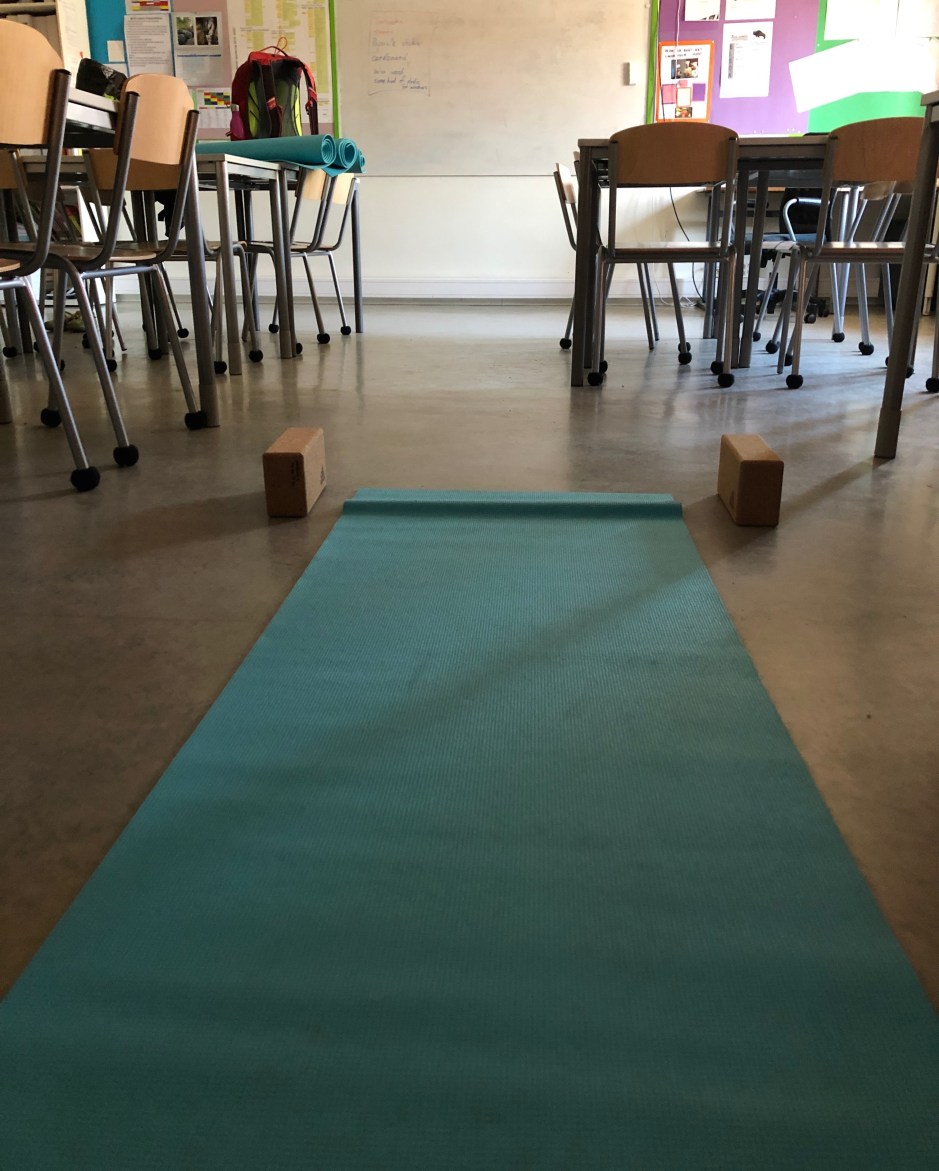
Sometimes, some extra time falls from heaven like today. Thursday last lesson, I teach yoga as an elective to some students in our school, but I had forgotten that their class was on a trip today. I prepared  myself and the classroom and nobody showed up. It felt so good to then spend the time to do my own asana practice and I even took five minutes to lie down in shavasana. It would have been too time consuming to change back to my regular clothes and tidy up just to try to get some work done before the end of the school day.

Sometimes, I have to create the time for myself like this week. I just didn’t feel like rushing through the house to get it cleaned during a weekday evening, I didn’t feel like hurrying up. Instead, I invited myself for a run by the sea in the gorgeous Spring weather, and left the cleaning for later this week. I genuinely felt revitalised that evening and the next day.

Everyday, I create a space and  time in the early morning to do my sadhana. This is non negotiable, but I keep forgetting that if I need something, the best person to provide it is myself. Never expect anyone to give you what you need, you need to take self-responsibility to take care of yourself. No one is going to ask you to stop spinning around because we live in a society that cultivates and encourages business, and you know what? That is nonsense.

Who do we benefit when we avoid judging?

‘He who is equal-minded among friends, companions, and foes, among those who are neutral and impartial, among those who are hateful and related, among saints and sinners, he excels.’  Bhagavad Gita ch6 v9

Lately, I have been reflecting on the idea of humbleness. This verse in the Gita might not be exactly about humbleness, but I think we need it in order to have the same balanced attitude towards everyone.

I have been asking myself if I am humble. Like anyone, in some aspects I might be humble, but I do observe that in other aspects, I get carried away by my opinions and I create a gap by opposing myself to things as they are compared to what I believe things should be, or to how people behave and how people should behave.

Why do I think about this? Well, I observe how, by going around judging situations and people, I create separation between me and the rest of the world and what is even worse, I create distress in my mind by labeling people and situations with either like or dislike.

My values, attitudes or actions are not “better” than others if they create distress. There is nothing wrong on being anchored in my own values and views but the challenge comes when I use them to place myself above others or to separate myself from others.

I might not like someone’s actions, but according to Yoga and other life philosophies, the action does not define the person. I sincerely believe that I benefit from accepting that someone acts in a way that I perceive as negative out of his/her own needs and perceptions, and then acknowledge that this person, just like me, is just striving towards his/her own well-being. I can also remind myself that just like this person, I have my limited sides and thus I have acted in harmful ways, I have made mistakes, and I will most probably continue doing so.

I once read an article about the gap that separates people with unreconciliable differences, and a way to find common ground can be to agree that they will never agree. I find this a beautiful example of humbleness, difficult to practice sometimes, but beautiful still. Why do we have to make those who disagree with us to our enemies? Can’t we just acknowledge that beyond our differences, we also have a lot in common?

I believe more and more that we waste quite a lot of energy by trying to make people change. The reason why I think this is because the more I look inwards, the more I discover how limited my mind is. I am aware of many of my weaknesses and negative attitudes, and still, I can’t just change them that easily. So if I can’t change myself so easily having access to my mind 24/7, what makes me believe that I can change others?

I also believe that it is natural to operate in this like/dislike realm, but we can try to be more cautious on how this affects us and those around us. What kind of environment do we want to create? If the answer is, a positive environment, then, do our negative attitudes help? We tend to forget that we always sit with the power of being the first one to take a step towards a space of acceptance and maybe even find a compromise.

Sometimes opposition can be a way to make people get together to create a group that feels cohesive and gives a sense of belonging, but how about rather try to create the space to include even those we disagree with? Can we see beyond differences and disagreements and recognize the human in everyone? Are we willing to create an even bigger group by including everyone instead of excluding some?

To achieve this, we need to cultivate values such as humbleness, compassion, empathy, and forgiveness. We also have to be brutally honest with ourselves and recognize the imperfection in our own actions.

Self-compassion

Let a man lift himself by himself; let him not degrade himself; for the Self alone is the friend of the self and the Self alone is the enemy of the self. Bhagavad Gita Chapter 6 verse 5

Compassion is an important aspect in the practice of Yoga and one of the core values in Buddhism. I recently asked both my adult yoga students and my teenage yoga students what compassion is for them, and their answers inspired me to write this post.

I can start like I did with my students by asking what is compassion for you? Take a moment to think about it before you read further.

The common definition that most of us use is being understanding and kind towards others. The definition in the dictionary is slightly different: sympathetic consciousness of others’ distress together with a desire to alleviate it.

Very few students include themselves as an important object of compassion when defining the word.  However, according to the Yogic and Buddhist traditions, in order to cultivate compassion towards others, we have to first cultivate compassion towards ourselves. If this is a new idea for you, take some time to reflect on it. Doesn’t it make sense? But what does that mean? How do we show compassion towards ourself?

I asked one of my teenage yoga students how she shows compassion towards herself, and she answered “by eating chocolate”. Eventhoug there is nothing wrong with enjoying something we like,  I think this illustrates how we sometimes tend to misunderstand what self-compassion is, and that is why I opened this post with the quote from chapter 6 in the Bhagavad Gita.

We often think that we are being kind towards ourselves by indulging in something, especially when we experience distress. It can be food, alcohol, TV, social media, you name it. In my perspective, this is only a way of escaping from that distress. We might get the illusion that we are alleviating it, but in reality we are just hiding it or pushing it away. That is not self-compassion.

Self-compassion requires courage, it requires the ability to see beyond our fear. We have to first have the courage to stop running away and face the source of our distress, which we often have the illusion comes from the outside world, but if we look closely, we will discover that it comes from inside us.

So, I wonder, when am I doing something ‘kind’ towards myself that will allow me to continue growing as a spiritual being and what am I using as crutches to avoid the fall, the pain, the distress?

I have already shared in a post the distress I sometimes cause inside myself because I get caught up in thoughts and emotions. I recently realized that I haven’t been showing self-compassion at all. Although it is positive to be aware of one’s flaws, one’s dark sides, it is harming to be judgemental about them. The advice in Yoga is so subtile, I think. We are encouraged to confront our inner darkness but we have to accept it first and then make small adjustments at a time. As a dear friend recently said to me, you need to embrace the monster inside you to move forward.

Only when we decide to live a life of awareness, of rude honesty towards ourselves, will we be able  be compassionate towards ourselves and thus lift ourselves forward.

In the process, compassion towards others starts to come easier and more naturally as we keep discovering our dark sides, our weaknessess and we then can identify with other people’s distress. This allows us to be less judgemental and more understanding, more tolerant, more willing to help.


A week of turmoil and Bhagavad Gita ch6

Ever since I was a little girl, I’ve had the tendency to get overwhelmed by the world around me. Or maybe it would be more correct to say, overwhelmed by my perception of the world around me. I don’t know why, but I tend to overthink and get carried away by my emotions. My dad used to tell me that I take life too seriously.

During the last five years, I have been studying and practicing Yoga with the hope that this side of me would fade away, but I still have periods where I get overwhelmed by all and everything, and to be honest, there is nothing to be so overwhelmed about. These episodes are maybe even stronger than before because emotions pile up as I want so badly to have control over my thoughts and emotions and I see how they get stronger and stronger until I can’t control them anymore.

I was listening to episode 94 of Secular Buddhism yesterday about The Five Hindrances in the Buddhist tradition: desire, aversion, disinterest, agitation, and indecision. One of the main points in this podcast is that we learn about these hindrances to be aware of them when they arise in our mind and to be curious and mindful but not to try to get rid of them.  I still have a lot to learn about my mind and what I can and cannot do about it.

I discovered that one of my biggest hindrances is that I believe that through the practice of yoga, I will no longer experience challenging thoughts and emotions. When they arise, I push them away, but after some time, they come back even stronger and that is when I lose my patience with myself and the rest of the world around me. Desire to control gets in the way of achieving a calm state of mind. The more I desire to be patient, the less patient I am.

My Yoga teacher encouraged me this week to study chapter 6 in the Bhagavad Gita. I am to savor one verse at a time allowing the message to sink in. So, here’s verse 1:

“Without dependence on fruits of action, he who performs action as duty, he is a Sannyasi and a Yogi. Neither without fire nor without action.”  

In this verse, we are encouraged to engage in the world with a sense of purpose and without any expectation. Everything we do, we do it as our duty, putting our best effort into it, and running away from our roles (like I sometimes really want to do) will not help.

Further, in verse 2 I read: “What they call renunciation, that know to be disciplined activity. O Pandava, for no one becomes a Yogin who has not renounced his (selfish) purpose. No one becomes a Yogin without renouncing expectation.”

The way I understand it we are encouraged to observe what drives us to act and discern between acting out of duty and acting out of need. We should then refrain from acting out of need, or at least be very aware of the motivation behind these kinds of actions and know that the outcome will mess up with our expectations.

So, I will experiment with this. When the need arises, I will sit with it, I will not reject it, but I will not put it into my actions because the outcome most probably will not meet the desired one and I will then again engage in the turmoil of my emotions. I will act out of duty, do my job in this world with my best intentions and efforts, knowing that the result is not in my hands.

I will continue with my daily Sadhana without expecting it to “fix” me. I will remember to be compassionate towards myself.

This is the path of spirituality, isn’t it? One step at a time. Learning, unlearning, adjusting our perceptions. Falling and standing up again. And in the meantime, hoping that those around us have the capacity to forgive our bad moments.

What I wonder about now is what are my real duties in life and what are my perceived duties?

What do you see?

When I was in my early twenties, I lived in France in a student city near the northwest coast.  During four years, my main means of transportation was the tramway.

I moved away from France, got married and had children. Some years after my youngest child was born, I took a housewife vacation to visit old friends in France. I remember so well taking the tramway the first day and being puzzled by the number of kids and young couples with strollers in the tram. I did wonder for a little while if the city had changed that much from having many students to having many young couples with small children…what happened?

I had changed! Not the city. I was now mum to three small kids, and my focus in life was completely different from when I used to take the tram back in my uni years. This really amused me back then. There most probably were children and strollers in the tram when I was a student, but I wasn’t paying attention to them. I was living in a completely different world.

Lately, I’ve been reflecting a lot about how we create our reality through our mind. Whatever it is that occupies our mind influences what we see around us.  We tend to see what we are looking for.

Our perceptions can influence the way we experience the world at different levels. My story about France talks about what was occupying my mind at two different stages in my life, but expectations can also affect the way we experience things.

I was born in a big city, and when I was six years old, my parents decided to move to a completely different place by the coast, about 1000km from the city. They had been there two weeks before on a work trip for my dad and fell in love with the place. My brother and I had no idea of where this was and how it looked like. All we could do to get an idea was to listen to my parents talk about it.

From what my mum said, and out of what my imagination was able to produce, for me, it sounded like we were moving to Disneyland – even though I had never been in Disneyland before.

We drove there, it took two days. For a six-year-old, that was a long road trip. In addition, the closer we got to the place, the hotter the weather, so I remember the last hours of the trip as a little torture.

When we finally arrived, I remember so well my mum being super excited in the car, and me being super disappointed. The place was a small town, the vegetation completely different from what I grew up with, and what is worse, it didn’t look like what I had imagined at all! I think I kept my disappointment to myself, but I remember it took a while before I understood why we had left our big beautiful house in the city for this.

My experience in this new place was affected by the idea I had created in my mind. I eventually came over it  because as it turns out, it was a great place to grow up in, but I often remember this episode in my life and I have to laugh because as an adult, I have experienced quite often the same. I create an idea of how things should be and struggle with the disappointment of how things actually are.

There is nothing wrong with dreaming and having objectives, I can almost hear some of you thinking as you read, and I agree, but we might want to be aware of the moments when our experience of reality is muddled by our expectations.

I don’t know how many times I have spoiled an experience for me and those around me because if this. Either because of too high expectations or because of my biased mind.

I once had a boyfriend with whom I was very very in love but I was sure he was going to end up leaving me for someone ‘better’ than me. I had convinced myself that he was with me to pass the time, and as soon as he discovered that I wasn’t that great, he would leave me for someone greater than me. I must specify that at that time, I wasn’t aware of this, this became clear to me later.

So, most of the time I was with him, I was interpreting all his actions and inactions as a sign of him soon dumping me. If he was kind, he was kind out of pity, if he has distant, he was distant because he was tired of me, or even worse, he had a better time with another woman. It was exhausting, mainly for me because I didn’t necessarily share these crazy thoughts with him.

My point here is, how many times I messed up the nice time spent with him because of my inability to be in the moment without interpreting every action, every word, every gesture?  I was so lost in my perceptions that I couldn’t open up to the here and now.

I have been having fun with these memories this week because, I now know how my perception affects what I experience and how I experience it. This can be a useful tool both to show more understanding of other people’s attitudes and actions and also to be more aware of my own attitudes and actions towards the world around me. Especially when experiencing challenges. Maybe the challenge doesn’t really come from the outer world after all!

This has also led to a mind game I’ve been playing recently. Imagine if we could wake up every day to a completely new day! We would never ever need to travel away to find new things because the reality before our own eyes would constantly be offering us the opportunity to be amazed, to be surprised, to see something new and refreshing. All that is required from us is to open our eyes and let the mind rest.