
Why develop compassion and forgiveness?

The yogis look upon all—well-wishers, friends, foes, the pious, and the sinners—with an impartial intellect. The yogi who is of equal intellect toward friend, companion, and foe, neutral among enemies and relatives, and impartial between the righteous and sinful, is considered to be distinguished among humans.’  (Bhagavad Gita 6:9)

How does this resonate with you?  What is your immediate reaction to it? Can you accept it? Why? 

If we define Yoga as equanimity of mind (Gita 2:48), does that change your way of understanding this quote? Why would this be important in order to have a calmer mind?

Although this quote doesn’t talk directly about compassion or forgiveness, for me, it is an invitation to practice both. Compassion is an important concept in many traditions. Have you ever thought about what compassion means for you?

When practicing compassion, we are always encouraged to start with ourselves. When you allow yourself to see inside your mind with complete honesty, you will discover both the bright and dark sides of it. Instead of criticising yourself, try to understand yourself. Try to understand why sometimes, you act and react in ways that do not serve you or those around you. It usually has to do with thoughts and ideas that are imprinted in your mind as a result of past experiences. When you are able to understand yourself, you are able to show compassion too. This is the first and most important step towards self-transformation. By observing, accepting and understanding, we create space between our thoughts and our actions, this space, with practice allows us to stop living a reactive life and start living an active life.

Once you are able to show compassion to who you are at any time, you will see that it is possible to show that same compassion towards others because you realize that they too, act and react according to their own mental limitations.

Compassion has two main benefits, the first one is helping you stabilise your mind, the second one is to interact with everyone in a more open and harmonious way.

Once you are able to show compassion, you might be able to forgive. Forgiveness comes from our willingness to let go of our expectations towards others. If you are struggling to forgive someone, try to think in the same line as with compassion. Someone once said that hating someone is like drinking poison and wishing the other person to die. When we go around with resentment towards others, the only affected is our own peace of mind. In addition, we can consider the fact that we all are seeking love, freedom and happiness, but we do it in different ways. We all act out of our patterns of thought and perception, and for some, there is a real feeling of no other choice. This can help us feel compassion and eventually forgive.

Recognise yourself in others.


What my Yoga practice does and doesn’t do.

Practicing yoga doesn’t stop me from getting frustrated. Practicing yoga doesn’t stop me from getting angry. Practicing yoga doesn’t stop me from feeling blue. But it helps me accept my frustration, my anger and my sadness. It helps me create a space between my emotions and my reactions. It makes me question my perspective. So I get out of my spiral of negativity faster. Yoga has taught me to find my balance over and over again. Therefore, study, practice and use what you learn on yourself. Fail, fall and get up again and learn. That is all we can do.

Yoga es destreza en acción

‘El unido con la Pura Razón se abstrae en este mundo de las buenas y malas acciones. Así pues, aplícate al Yoga, porque el Yoga es la habilidad en la acción.’ Bhagavad Gita, capítulo 2 verso 50.

En el Bhagavad Gita encontramos tres diferentes definiciones de lo que es yoga. En este verso, yoga es el arte de toda actividad realizada con la actitud apropiada. Esta definición guía el camino llamado Karma Yoga.

Al seguir el camino de Karma Yoga, aprendemos a tomar conciencia de todo lo que hacemos y poco a poco ajustamos nuestras actitudes y acciones para armonizar y calmar la mente. Una mente tranquila y en armonía es el vehículo ideal para alcanzar nuestro potencial absoluto. Para la mayoría de nosotros, es un proceso largo que requiere paciencia y mucha práctica. El Gita nos da varias herramientas para desempeñar nuestras actividades cotidianas con destreza y un efecto secundario de seguir este camino es que poco a poco vivimos una vida más clara, más tranquila que nos beneficia personalmente y beneficia a todos los que nos rodean.

Una acción perfecta según la teoría de Karma Yoga es una acción realizada sin apego al resultado. La intención y la acción son nuestra absoluta responsabilidad pero debemos aceptar que no tenemos ningún control sobre el resultado. Si tengo mis intenciones claras, si pongo lo mejor que puedo dar de mí en cada momento, el resto está fuera de mis manos. Así, al actuar en el mundo, si las cosas no salen como yo lo espero, en vez de perder energía en dar rienda suelta a mis emociones de frustración, enojo y/o tristeza puedo ver la situación como es y ya sea encontrar una manera adecuada de lidiar con ella o aprender la lección que hay que aprender y seguir adelante.

No quiere decir que tenemos que suprimir nuestras emociones a toda costa, lo que quiere decir es que podemos reconocer que la frustración, la tristeza y el enojo que surgen no son nada más que el resultado de nuestras expectativas. Al reconocer nuestras expectativas y las emociones que producen cuando las cosas no salen como queremos, podemos intentar no reaccionar de manera emocional. Con práctica, esto nos da tiempo para actuar de manera más positiva al mismo tiempo que nos ayuda a crear un estado mental de calma y armonía.

La teoría del Karma yoga nos invita también actuar con una actitud altruista. Este concepto es un poco más difícil de entender pero pienso que lo importante es que cada persona encuentre la manera de desarrollar esta actitud en su vida según su entendimiento y sus capacidades prácticas. En ningún momento quiere decir que tenemos que descuidarnos, al contrario, para vivir en yoga tenemos que aprender a cuidarnos. Pero tal vez nuestra definición de cuidarnos necesita ajustes.

Para entender un poco mejor el concepto de altruismo en Karma Yoga, es tal vez importante saber que según las enseñanzas del yoga todo lo que necesitamos lo tenemos al interior de nosotros. La felicidad que buscamos en el mundo exterior es parte de nosotros, la libertad y el amor que tanto añoramos, nunca nos han faltado. Lo que necesitamos hacer es dejar de perseguirlas en el mundo exterior, calmar la mente y aprender a dirigir nuestra atención hacia adentro. Al dejar de creer que el mundo exterior tiene todas las respuestas, nos damos cuenta de que podemos soltar mucho de lo que creíamos necesitar: objetos, relaciones, títulos, etc.

Podemos aprender a observar cuándo estamos actuando por una especie de necesidad emocional y cuándo estamos actuando por hacer nuestro deber en cada papel que desempeñamos. Este es otro concepto importante de Karma Yoga. Todos tenemos diferentes papeles que desempeñar en nuestra vida: mamá, esposa, hija, profesional, amiga, etc. Es nuestra responsabilidad entender qué es lo que cada papel requiere de nosotros y cómo mejor podemos actuar en cada papel para el bien de todos, incluyendo nosotros mismos.

Destreza en acción es aprender a actuar con conciencia, aprender a actuar con intenciones puras y claras, aprender a actuar con la meta de ayudarnos a calmar la mente y así poco a poco conocernos mejor. En Karma yoga no es necesario hacer nada especial, solamente hacer lo que ya hacemos con una actitud de desapego, de altruismo y de ‘esfuerzo sin esfuerzo’. Al vivir una vida de claridad y desapego, nos damos cuenta que no hay necesidad de empujar, de presionar. Para esto es importante aprender a tener fe. Fe en nosotros mismos, en lo que hacemos y en lo que la vida nos manda para aprender.

Late Friday reflections

When things don’t go as I wish them to go, my mind has a tendency to seek a culprit. Sometimes it is me, sometimes it is someone else. But, what do I win by blaming and criticising? I only feed on my distress and limit my perception. This, in turn, can have a negative impact on the way I deal with the situation. Things go as they go and we all have to reflect on the what, why and how of our actions, and I am starting to believe that we waste time by trying to guess or judge the intention other people put in their actions. We can communicate in a constructive way how their actions affect us and try to find solutions together, but blaming and criticising only shuts doors.

I had my yoga elective with yr6 and 7 today, and I chose to talk about the concept of light. Our mind has both a light and a dark side and they complement each other. Without darkness, we wouldn’t appreciate the light, and vice versa. Still, I believe that although we need to accept both our light and dark sides, we can learn to reach in for the light and choose away the dark in any given situation if we practice enough. In my interactions with other people, I can choose to act out of light instead of darkness no matter what the other person does.

One student asked, but what if the other person is evil? In this case, we can apply a deeper definition of the concept of light. According to the Yoga tradition, our heart is a cave in which burns the light of our soul. What we call soul in English is called atma in Sanskrit. This is our deepest and purest essence. This light or atma is equally bright and pure in each human being.

Then my student asked, but how can the soul of an evil person be equally light as the soul of a kind person? To this question, I love the answer from the Gita, we all have a pure soul, but not all of us are aware of this. Since we have lost contact with it, we feel some sort of vacuum, and so we go around trying to fill this vacuum with what we believe will make us feel complete again. This means that we sometimes behave in undesirable ways. So a person that does evil actions is not evil. Or better said, his/her atma is not evil, just the action and this action comes from ignorance.

My yoga teacher recommends us to 1. live with the heart on our sleeve (= live in love) and 2. try to always see or at least accept the pure potential in every being. I like these two principles, and I constantly have to remind myself to go back to them.

This week challenged me a bit more than previous weeks. It is the end of the first semester and, as always it is hectic and slightly chaotic. The Winter and the darkness have taken over in Trondheim making it difficult sometimes to stay awake. And then some dilemmas in my working space and family life arose. I felt like I didn’t have energy to deal with them. I felt overwhelmed. Until a dear colleague reminded me of the gift challenges represent in the spiritual path. I loved the analogy she made “they are the dead mice that your cat brings in to your house”. This helped me remember that yes, I can deal with this and more if I only remember to trust in myself, trust in the process and use the tools I have been learning to use in the past five years.

Today, I am so grateful to be surrounded by so wonderful women in my life. Most of them in my working space. How lucky can one be by having such resourceful, inspiring, caring and fun colleagues!

We’re getting there

This year, I teach yoga as an elective at the school where I work. This isn’t the first time, and it is taking me many years to create a program that I feel is both meaningful and appropriate for the age of the students.

Last year, during the Spring semester, I was teaching to only tenth graders, which are around 16 year old. With inspiration from a research program I was invited to participate in called Hippocampus, I tried to create a program for those girls for that semester. It worked quite well. I introduced asana very slowly throughout the weeks. First, with mainly just some joint mobilisations and relaxing poses on the mat, and gradually, I started introducing standing poses.

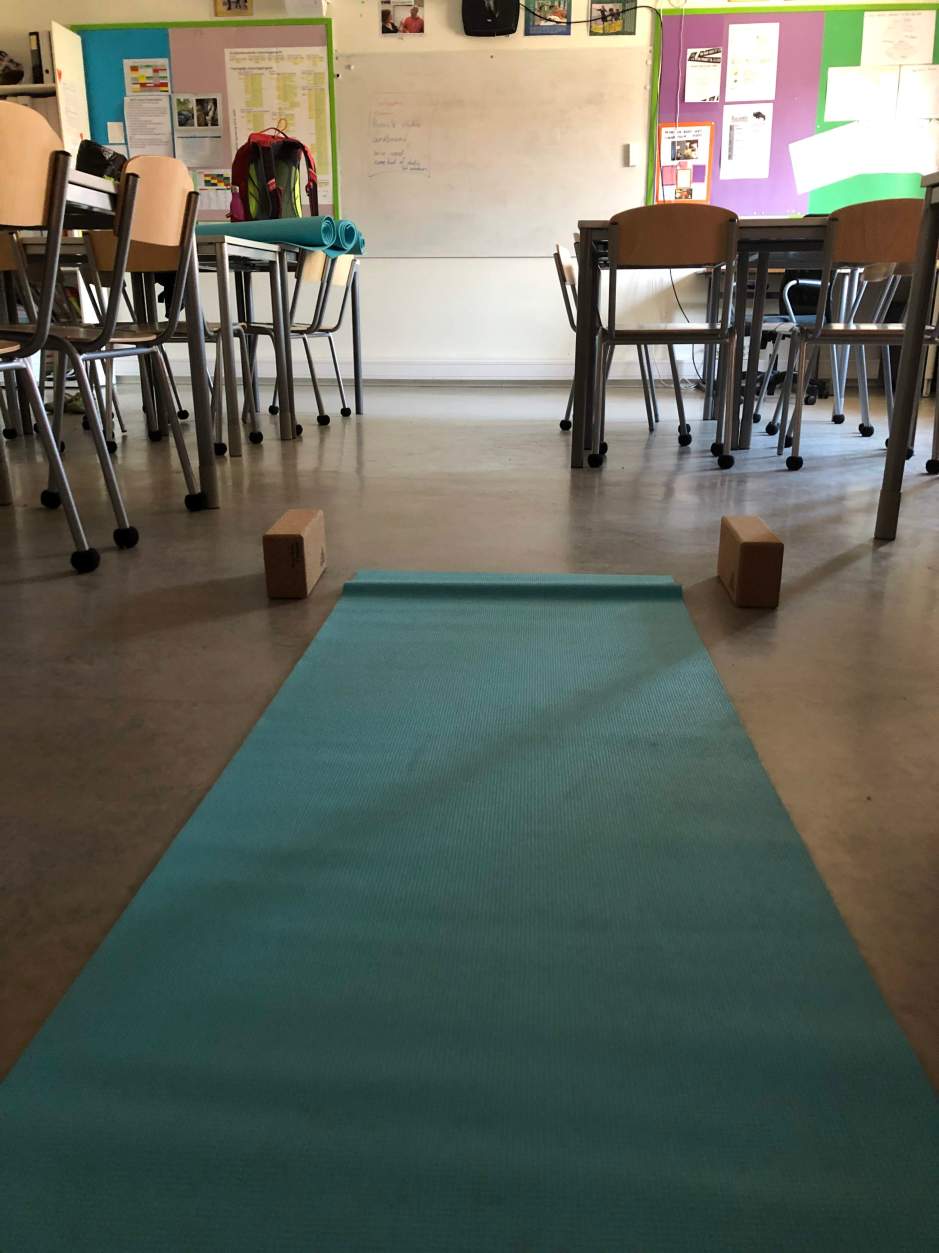
During one hour, we would only do about 20 minutes of asana, around 15 of reflection on a topic I thought was relevant for them (self-esteem, stress management, emotions, relationships, etc), and the rest of the time they lied down on their mats for a body scan and simple breathing exercises.

I felt that the girls enjoyed it and that they got something out of it, so this year, I decided to ‘repeat the success’. What I didn’t count with is the fact that these electives are open for all students between 11 and 16. I ended up with a group of 11 girls (boys rarely sign up for yoga, unfortunately) between 11 and 12 years old.

Very soon, I understood that the program I had made for yr10 wasn’t going to work. These girls are much more active, they aren’t used to be still, and they are constantly looking for each other’s attention (this is very age appropriate). It is very interesting to see, and it has been a fun journey to teach them since September.

I still feel that it is my duty to introduce them to Yoga beyond asana, so I tried to structure each lesson with a bit of asana, a reflection and some relaxation. The asana I teach is very simple because I want to move away the focus from doing ‘fancy’ poses to get to know their bodies better. Many of them don’t exercise much, and they benefit from moving their bodies and strengthening them through simple asana.

I gave them a notebook too, where they can write or draw during the lesson, and I sometimes ask them to write something in particular.

I am trying to find the balance between giving these girls the space to be who they are and how they are, and trying to guide them towards the idea of relaxing the mind and the body, and towards the habit of getting to know themselves better. It sometimes feels like my lessons are filled with chaos, especially when we do asana. There is not much breathing going on, not much focus going on, they just want to do the pose and then it turns into dancing, jumping, and running around. But when I ask them to lie down for relaxation, I do insist in silence, and I am noticing that they are managing it better and better for each lesson.

I found a book called Stories from India by Anna Milbourne at the public library, with short cute stories that invite for reflection. I am now reading them one story in the beginning of each lesson while they lie down on their mats, and we then discuss what they think is the message. This is working very well, and we like the stories in the book.

One of the girls, a seventh grader (around 11 or 12 years old), has been slightly annoyed with the fact that we don’t do more ‘fancy’ poses. During the past weeks, she keeps asking me what yoga is, but she doesn’t really wait for the answer. She is trying to figure it out herself.

This week, I did a more fun session that I found in a Yoga for kids book called Yoga games for children by Danielle Bersma. I took one of the chapters about poses and modified it slightly and we were mainly rolling up and down on the mats working with the abs. I also read a story and we discussed the message, and they did some relaxation.

At the end of the lesson, when I was tidying up my things, the same seventh grader came to me and said, “Yoga is not physical activity, is it?” Before I even tried to answer, she said “Yoga is mental training, isn’t it?” and she left. I guess it is a good definition, isn’t it?

I am grateful for this class. It teaches me so much. I am thankful for these girls and all the kids at our school that sign up. I realise that being a Yoga teacher is not different from being a school teacher. We cannot have a fixed program that fits every class. We have an idea of where we want to lead our students, but we have to adapt the how to who and where they are in life/development, and we sometimes even have to adapt our idea of what they need.