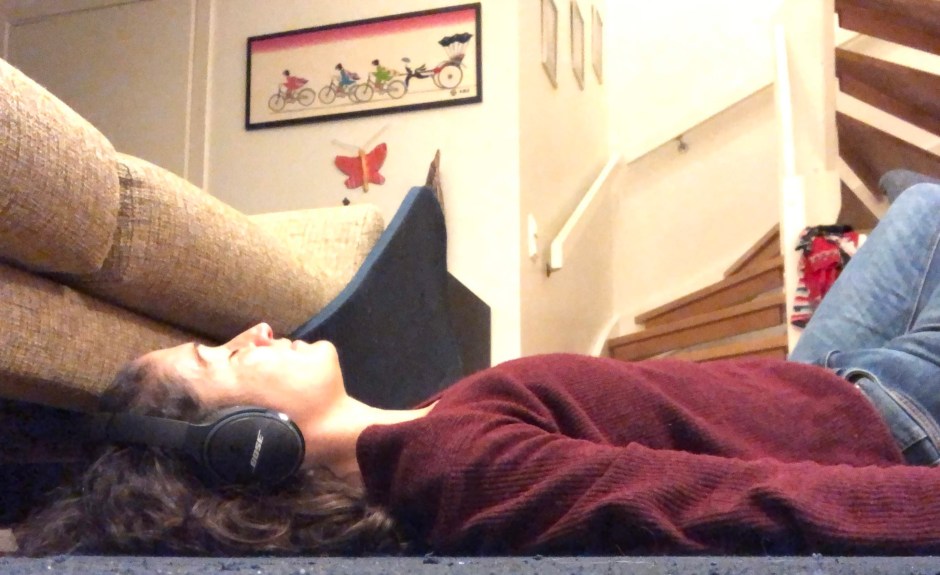
A very simple view on meditation

The practice of meditation in the Yoga tradition is more than sitting in lotus pose to ‘not think about anything’. It is a process that requires constant practice even -or better said especially – when we are not sitting in silence (no need to sit in lotus pose by the way).

Like in all paths of Yoga, the purpose of meditation is to help us come closer and closer to the core of who we really are, and to achieve this, the attitude we have towards our practical life needs to gradually help us cultivate a quieter, calmer state of mind. If our mind is all over the place 24/7, it is very unlikely that we will be able to sit and meditate in silence for some minutes. So it is like a circle, the practice of siting in silence with yourself teaches you to slow down, to calm down the body and the mind, at the same time as applying some basic principles to your everyday life will also help you cultivate this calmer and more harmonious state of mind that in turn will help you in your meditation practice.

This said, the best is to start somewhere, and using apps such as Head Space or Insight Timer can be a good tool to help you establish a regular practice. Both apps offer guided meditations in different styles and with different lengths that can vary from 1 minute to up to one hour or more. Spend some time exploring the different guided meditations they have and either pick a course (a set of guided meditations with a specific topic or purpose) or a couple of meditations that you like, and stick to them. You will need to try quite a few since the voice, pace and music/no music need to be suitable for you.

I recommend that you try avoiding jumping from one guided meditation to another because if you do so, all you are doing is serving your mind with some sort of ‘entertainment’.

I have tried guided meditations using these two apps, and I like using them mostly to take a break during the day, especially when I am tired, like for example those under the categories of Yoga Nidra or Body Scan, but when I want to slow down, to be with my mind, I prefer to sit down in silence and only use the timer from Insight Timer. I usually start with some simple breathing exercises, and then I sit down and focus my attention on my breath. Most of the time I start thinking about what has happened, what will happen, or what should happen, and when I notice this, I move my attention back to my breath. It is like a dance, and so we dance, my mind and I. No judgement, no pushing, just patiently observing.

Whether you choose to use a guided meditation or try sitting in silence, the very first thing you need to do is to convince your mind that you do have the time to sit down every day for at least three minutes, in a quiet space and spend some time on your own. Once you get so far, you need to have the patience and discipline to stay. Thoughts will come and go, especially thoughts about what you should be doing instead of sitting here and doing nothing. This doesn’t mean that you can’t meditate. On the contrary, it is part of the process. So just observe your thoughts come and go, let your mind tell you whatever it wants to tell you, but sit until the timer rings. With practice, it will get easier.

In this kind of practice, as with anything else you engage in, you need to have it very clear for you what it is that you want, what your motivation is. If your motivation is ‘just’ to relax and take a break from everyday life, I then think you can use any of the mentioned apps or you can also find quite a few guided meditations on YouTube. If, on the other hand, you want to cultivate a lasting calmer state of mind, you will need to do a slightly harder work and learn to sit in silence with yourself , and seek for some guidance to learn some of the basic principles of Yoga that complement this practice.


Humbleness

When things start loosening up, when life smiles at you,
Remember to keep your heart humble.
Focus your attention on the Divine.
Offer your actions to the Divine.
The goodness that might appear in your path
dedicate it to the good of all and everyone.
Stay focused. Stay humble.
Don't stop practicing. Don't stop searching. Be patient.
Be kind, especially with yourself. Be calm.
Be spontaneous but not impulsive.
Don't be afraid anymore.

Santosha or contentment

From contentment and benevolence of consciousness comes supreme happiness’  Iyengar, B. K. S.. Light on the Yoga Sutras of Patanjali

Contentment is an important ingredient in the life of a yoga practitioner. In my understanding, we need to keep it in mind at all times during our everyday life in order to channel our energy in the right direction and cultivate a calmer state of mind but it is also something I can notice developing on its own inside me as I walk on the path of Yoga.

The what, the how and the why of contentment we try to generate.

Firs of all, what do I understand by contentment? I tried to find a translation in Spanish for one of my students but all I could find was something that translated back to English is “happy”. In my opinion, it is more nuanced than that. Being content is not necessarily being happy. Being content is more like being ‘okay’ no matter what. Noah Rasheta from Secular Buddhism defines it as ‘okayness’. This means that no matter what life is serving you today, you try to stay balanced. Why? To save energy mainly. Mental energy. If you don’t waste energy in getting all worked up in everything that doesn’t go your way, you can then direct your efforts towards dealing with the situation more appropriately. You avoid reacting out of impulse and you start acting more skilfully.

Contentment is one of the four niyamas in Patanjali’s Ashtanga Yoga. We are encouraged to practice it together with cleanliness of body and mind, sustained courageous practice, self-study and surrender to the supreme Self or God.

Being content means that when things go the way we wish them to go, we enjoy them and let go when we have to let go of them, and when things don’t go as we want, we focus on what can be done and what can be learned instead of getting lost in negativity. Not because negativity is ‘wrong’ but because most of the time, it won’t lead us towards any constructive action.

As one of my students put it today, if you get lost in negativity, you can’t get the whole picture of what is happening around you which may also include positive things. I loved this reflection!

Another way of cultivating contentment is to be tankful for what we have or for what does go as we wish it to go. It might sound difficult when we are in the middle of a crisis, but if you think about it, we can always be thankful for something: for being strong enough to endure this difficult situation, for the support we receive from others, for the food we get, the clothes we wear or the bed we sleep in.

How does contentment start growing from the inside?

When we constantly practice non-attachment to the results of our actions and at the same time put our best intentions into them.

Detachment brings discernment: seeing each and every thing or being as it is, in its purity, without bias or self-interest. Iyengar, B. K. S.. Light on the Yoga Sutras of Patanjali (Kindle Locations 774-775). HarperCollins Publishers.

It requires a lot of practice, but when we manage, the feeling is of pure freedom. When you can tell yourself: I did my part, the rest is out of my hands and you really let go. If the result is the desired one, we are thankful, if not, we try to find the lesson in it, and move on. Done. No need to dwell on it. Freedom and contentment.

When we learn to trust. Trust in ourself, trust in the journey, trust in our guide(s), and/or trust in the Universe/God or however you want to call it. You stand up, brush the dust, and keep walking.

When we understand that our inner peace is independent of external stimuli. When we understand that what lies at the core of our being is independent and unaffected by anything that is external to us.

But the individual who truly loves the soul and is fully satisfied with the soul and finds utter contentment in the soul alone, for him no duty exists.’ Yogananda, Paramahansa. God Talks with Arjuna: The Bhagavad Gita Ch11 v17

Allow

Allow, flow with life and take time to observe what is happening. Avoid labeling every situation as good or bad. When we refrain from liking/disliking a situation, we let go and can act more skilfully. We neither run away nor cling to what is agreeable. 

Allow yourself to experience feelings and emotions. Allow yourself to experience what we call difficult emotions. Do not suppress, but do not feed into them. Be curious. Where does frustration, anger or sadness come from? Can you find the source inside you? Is it because of attachment? Is it because of expectations? Can you let go? If you are not ready to let go, do not push it. Just observe when they come, and as you would do with someone you care fondly of, be kind towards yourself, show compassion and understanding and tell yourself that slowly, little by little you will be able to let go. You can start by being aware.

Allow people to walk in their path, show the same curiosity, compassion and understanding, but do not allow their actions to disturb your inner peace. Remember that we all seek the same in different ways. That we all make decisions out of what we perceive and expect. 

Allow, flow and see how a lot of energy is saved, the energy you can use to live a clear and more creative life.

Be patient, it takes practice and time.

‘Behind all our efforts, our basic motive is to find happiness and thus to find peace. All our actions are for that good. We are all working toward that happiness. Even all these wars, fights and competition are ways people look for happiness. Even when people steal things, they think they are going to be happy by stealing. So the ultimate motive behind all our actions is to find that joy and peace.’ Sri Swami Satchidananda in Living Gita

What’s up with Fridays? or Friday, My New Teacher

I am trying to live my life following a simple yet sometimes difficult to follow principle: put my energy and creativity to do my part in everything I undertake and let go of the expectation of the result being as I wish it to be. This is a very nice way to focus my mind and energy in doing as good as I can and not wasting it in worrying about the outcome or getting all worked up by perceived failure.

This said, when things do go well or even better than I could imagine them to go, it kind of becomes addictive so when something doesn’t go as smoothly and well as the rest, the fall feels harder. This is quite funny when I think about it, but not that funny when I’m in the middle of it .

The last couple of weeks have been what I would call ‘good weeks’. I feel motivated, inspired and creative at work. My colleagues and I had been working on a couple of projects for our students, and they seem to have worked well. Students had fun, and we believe they also learned something.

I have been offered to teach two groups of ‘corporate yoga’ at a company where I have worked before and people seem to enjoy the classes. I have many ideas for these groups and I am so happy and grateful to get this opportunity.

I will start teaching two other evening yoga classes at a new place where I have been given the freedom to decide what to teach and how to teach it. I also have many ideas for these two classes, and I am super happy that the owners of this place asked me to join their team.

My kids and husband are doing well, everything is running more or less smoothly at home with daily routines, kids’ after school activities, and so on.

Happy days but busy days. So the past two weeks, when Friday comes, I kind of expect it to go as smoothly as the rest of the week only even better because IT IS FRIDAY. Finally the day to ‘relax’ has come.

To my big surprise and frustration, both Fridays have been the most challenging days in both weeks. Just when I am starting to let down my guard, one by one small challenges, like obstacles in a race, start appearing and I notice how little patience I have to deal with them. I experience a combination of frustration and amusement watching myself become more and more angry because the day of the week that should be the ‘best day’, turns out to be the least relaxing.

What happened? Nothing big actually, but combined with my expectations on how things should be, it can feel quite big.

Last week, I struggled to keep my cool when the lady at the drugstore behaved in a way that I perceived as condescending. The frustration was not just because of how I felt I was being treated, it was combined with frustration against the health system because I have been trying to get in contact with one of the specialists that see our daughter to renew a prescription and it felt like Mission Impossible. Then the pharmacist, who of course doesn’t know this, wasn’t being helpful. I was tired after a ‘good’ but busy week, and I noticed myself getting angrier and angrier. My dad has a say ‘el que se enoja pierde‘ , ‘the one who gets angry looses’ (I’m very bad at translating these proverbs, I hope you get the point). So, I lost it, and I just had to get out of the drugstore to not get even more angry and say something that I would regret afterwards. Did the problem get fixed? Nope. So I kind of lost.

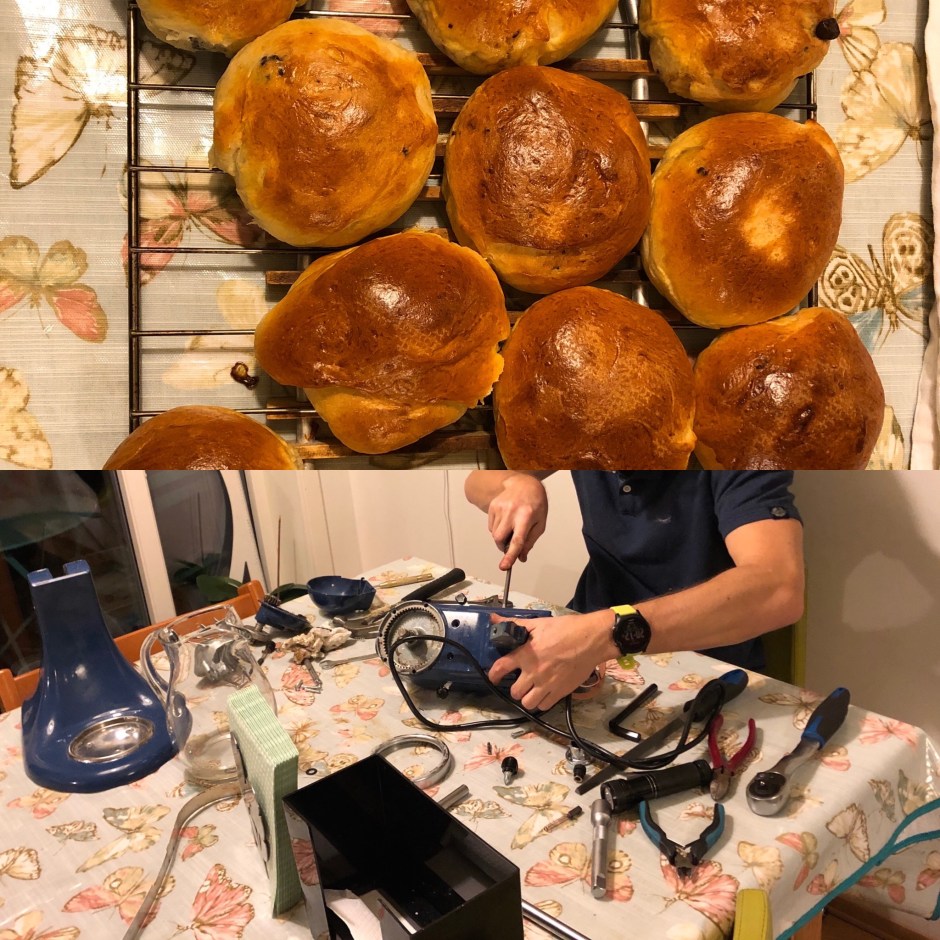
This week, the same story repeated itself but instead of a tired pharmacist, I met my tired ten year old Kitchen Aid. I had the ambition of making bread buns for the yearly voluntary work to get the neighbourhood ready for winter tomorrow morning. I wanted to make two batches. It was going to be a ‘cozy moment’ between my oldest daughter and I. Half way through the process of kneading the first dough, the Kitchen Aid said ‘bye bye’ and stopped working, and not only that, I couldn’t get the bowl out of its base to take the dough out. After five minutes of ‘patiently’ wrestling with the machine, my daughter standing by my side looking more and more worried, I just had to stop and observe myself for a minute. The thing is that I wasn’t only frustrated because the machine stopped working, I had already started making many connections in my brain. First, ‘what am I going to do without my Kitchen Aid?’ Followed by, ‘some weeks ago the electric whisk died, then the blender, and now the Kitchen Aid? What is wrong with our house? What am I going to do? I don’t want to knead two doughs tonight. It is going to get late and we won’t have time to watch that series we like to watch all together?, Our youngest daughter is going to be so disappointed?’ , and so on.

I took a deep breath, and went to get a rubber hammer from the basement to ‘gently’ encourage the bowl to let go of the base. My daughter’s eyes were as big as plates but I managed. And we continued our ‘cozy’ evening with me getting some extra arm strength as a bonus.

To be honest, now that I think about it. I am happy these kitchen appliances have been one by one saying goodbye. My kitchen counter has more space, and I can still cook a decent meal without them. I believe in trying to repair things when possible, but these three were old and cranky, so we can say goodbye with good conscience. Plus, my husband had a good time dismantling the whole thing.

I take with me some reflections for next week, and hopefully when Friday comes, I will be ready for its challenges. One: keep my expectations in check to avoid unnecessary waste of energy in frustrations. Two: make sure I take time to rest and do nothing from time to time from Monday through Thursday so when Friday comes, I still have energy to deal with whatever is. Three: keep practicing detachment, especially when it comes to material things. I have so much more than I really need, it is maybe only a gift to be encouraged to live in a simpler way.

Luckily, the buns turned out quite good. My kitchen looks tidier, and I can now go to bed with a smile in my face.