Observing the seasons

We live by the Trondheim fjord, and just a few meters from our place, there is a long path of about 10 kilometers with varied natural landscape. We’ve been living close to this path for fifteen years now.

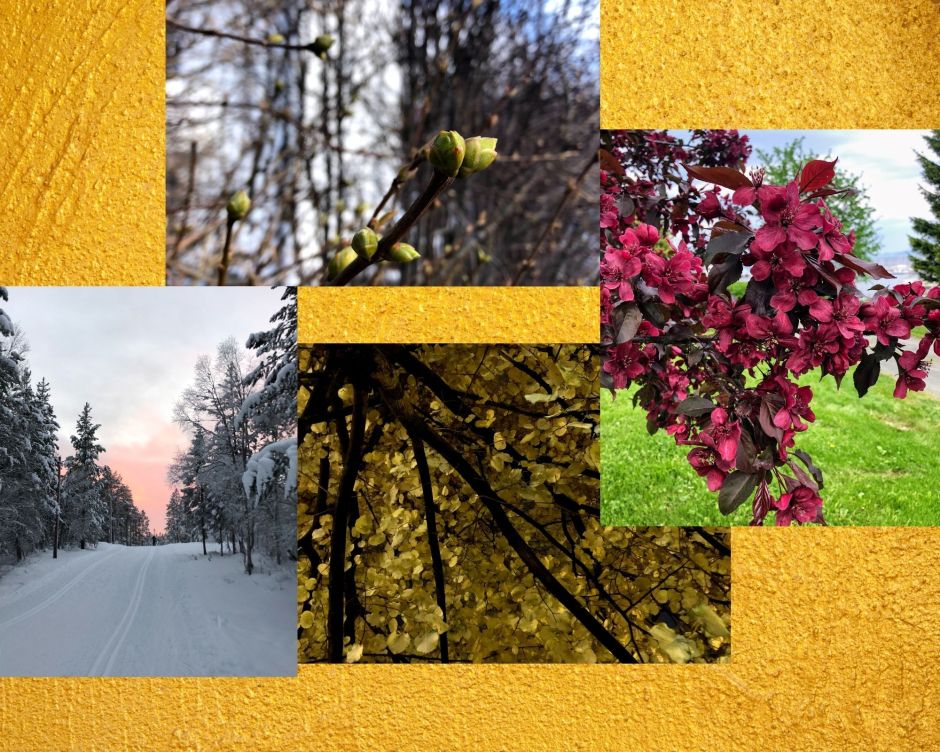
Throughout the years, I have learned to be more observant of the changes that each season brings. Spring probably being one of my favourite. I can notice the changes almost from day to day. From hearing the song of the robin and the blackbird, to the first sprouts on the trees and the ground. It first goes relatively slowly and all of a sudden, with some days of stable sunny weather, it is like an explosion of shapes, light, colour and sound.

It is with the same awe but also a pinch of sadness that I observe the end of the Summer and the start of the Fall, and the same way as Spring just explodes in front of our eyes, the wonderful warm colours of the Fall suddenly invade the landscape. Before we know it, the first snowfall comes, and the long Winter starts.

With the changes in temperature and weather come also the changes in daylight. I think this change is the one that has the most impact in the rhythm of my family’s everyday life. Every year, it takes us some weeks to adapt and find a new routine.

During the darkest months, from November to the end of January, we spend a lot of time indoors. During the weekends, we allow ourselves to sleep in, and spend our evenings watching movies or playing board games. In February, days start getting longer, and we suddenly discover that the sun is out while we are still in our pyjamas so we make the conscious change in routine of getting up earlier during the weekend and get out of the house for a skiing trip or at least a walk in the sun.

During the summer, which can be quite short here in Trondheim, as soon as we get some days of sun and hot weather, we are out the whole day, maybe even part of the night as the sun goes down only for a few hours. Its the summer holiday so we can allow ourselves and our kids to sleep less, or har slightly messier sleeping routines, just to be able to enjoy the nice weather.

Lately, I’ve been thinking about this cycle, and how, the changes in the weather and daylight influence our lives, and most of the time, we just make the necessary adjustments without much resistance. When it snows, I check the online skiing map and I plan for a skiing trip. When the snow melts, we put on our hiking shoes and go for a hike in the forest or by the fjord. If it’s raining, we take our rain clothes, if it’s hot and sunny, we put on a hat… Sometimes, I go out with my winter coat to discover that it is about time to change it for the thinner one, and I just make that change next time I go out.

This adaptability and flexibility we need to show with the change of seasons, and the trial and failing that we also experience, are good lessons for life otherwise. Life is full of changes. The most certain one is ageing. When our kids are born, they have certain needs, and as they grow up, these needs change, and we have to adapt our parenting to better meet these needs. As they grow older, we start giving them the tools to meet their own needs instead of catering all the time for them. But, just like with the seasons, it the changes require that we sometimes stop and observe what is going on. Ask ourselves what are we doing and why are we doing it that way. Consider a change of course, or just a change of attitude.

One thing that I keep reminding myself about is not to panic when I notice that a habit or routine is not working, or when one of my kids is struggling. I’ve noticed that unconsciously, my mind goes to what I like to call the ‘that’s it’ modus. It all seems hopeless and lost, but as my grandmother used to say “everything has a solution except from death”. As long as we are alive, we are always capable of changing and adapting to create a harmonious life for ourselves and our loved ones. We can make it as easy as putting on our rain pants by avoiding mental and emotional resistance and trying to just flow with it. Sometimes we also have to accept that our kids go through tough periods and all we can do is be present, give them love, understanding and compassion, and allow them to find their way.

Although the changes we experience in our lives seem linear as opposed to the changes of season that are cyclic, we can also see our lives as cycles. Changes might sometimes bring a period of confusion, of chaos, of instability, but with work, we find a certain balance and stability until a new change comes.

Are you your own friend?

5-6  “I must emphasize, Arjuna, that you have to lift yourself by your own efforts! You must not allow yourself to be demeaned by your ego-self. Know that the self can be both friend and foe — a friend when used to conquer the mind, senses, and body; a foe when it drags one into the mind, senses, and body. True Self (Atma) is the ally; the ego-mind self is the enemy.
Hawley, Jack. The Bhagavad Gita: A Walkthrough for Westerners (p. 58). New World Library. Kindle Edition.

These are the empowering words of Krishna explaining meditation to Arjuna. Meditation as a 24/7 practice. Meditation as a mindset: to learn to control the mind to quiet the cacophony of thoughts and thus be in touch with your inner peace.

When we sit in silence, we aim to slow down the body and the mind, to shut the senses, and focus our attention inwards. It is inside ourselves, beyond our thoughts that we can find lasting peace that is unaffected by whatever is happening around us. But it takes practice and time, and it requires that we also do some inner work the rest of the day, when we are not sitting in silence.

We can be our own friend and our own enemy when seeking this inner peace. Our mind often seems to live a life of its own. It often seems like emotions and thoughts arise without us having much control. Therefore, we are encouraged to observe the thoughts and emotions that are limiting us, and work towards gradually letting go of them.

You can start by observing your self-talk. How do you treat yourself? Are you your own friend or foe? Can you change your self-criticism into constructive feedback? How do you respond when you make a mistake? When things don’t go as you expected them to be? Do you mentally drag yourself further down? Start practicing self-compassion. Whenever you notice your negative self-talk, say something nice to yourself that will help you in the moment instead of make you feel bad about yourself.

Next, is to observe your recurrent thoughts. Those that keep your mind busy. Where do they come from? How do they make you feel? Are you ruminating about the past or worrying about the future? You can’t change the past, and all you can do about the future is to be clear about your intentions behind your actions, and do your best. Regret and worry won’t help you. On the contrary, since you are spending mind energy in regretting or worrying, you are loosing the opportunity to use that energy in being aware of the present moment. When we don’t spend mental energy in regret and worry, we have more time and space to better enjoy the present and better deal with the challenges it might bring.

Past events do have an impact in us, but we can also do the mental work to let go of what is out of our hands. Acknowledge the emotions that those past events have created in you (or others), and again, use compassion and understanding to let go of them. There is a difference between accepting and acknowledging emotions and feeding into them. You can be your own friend by allowing yourself to feel, tell yourself that you understand, and invite yourself to move forward, to let go.

The future might seem overwhelming sometimes, especially when facing challenges. Tough periods are tiring and draining. Try to find the confidence in yourself that you will be able to walk through this too as you always have. There is always a lesson to be learned, and fortunately, things are in constant change. A period of difficulty will be followed by a calmer period. You can create inner peace to better go through whatever life is throwing at you, and again, with this inner peace, you will be able to better deal with anything.

The inner work we do in our everyday life has an effect in our meditation practice. When we learn to befriend our mind and let go of thought processes that do not help us, our mind is calmer and it is easier to focus our attention when we sit. This again has an effect in our mindset for the rest of the day. In order to slow down the mind, we need to practice meditation both when sitting and when playing our parts in life.

Krishna also mentions the body and the senses. I will come back to them when sharing other verses.

Conflict and chaos

It is interesting how, with age I gain perspective, and with this perspective, I am more willing to see unpleasant situations as opportunities to grow rather than potential mini-apocalypses.

I have never liked conflict. I have always been afraid of ending up in an argument because conflict for me has always seemed as the end of something. It has taken me a while to understand that this is my attitude towards conflict, and that it is not healthy. I think it is because I know that when in conflict, we show our worst side, and I have always been afraid of my own behaviour when angry and maybe even worse, getting hurt and disappointed.

I have also seen conflict as a sign of irreconcilable differences. If we fight now, it must be because we shouldn’t even be talking to each other in the first place.

I have had a similar attitude towards chaos. I don’t like chaos. It makes me feel out of control. I don’t necessarily feel the need to be in control all the time, but I do feel that it is expected from me- as an adult, as a mum, as a teacher, as a wife- that I am in control of all situations and especially of myself. So, if I end up being in the middle of chaos, I panic, I loose patience, and I feel low self-esteem.

However, during the last few weeks, I have been changing my mind towards these two dreaded situations, and I am starting to think that they are necessary for us to recenter ourselves, create change around us and allow growth.

The key is to not let ego get in the way which, as usual, is easier said than done. Usually, when conflict arises, it is because there is a need to stop, evaluate and consider realigning ourselves. It is also a great opportunity for us to revisit our values and priorities and act accordingly. Sometimes, this might mean that we have to let go of a certain idea we have of ourself, the other or the situation we are in for the benefit of the whole.

Sometimes, when we are in the middle of a conflict, we might feel that the opposing parties want completely different things, but if we look closer, we might realise that the needs at each extreme are the same, only manifested or expressed in different ways. This can help us open up, listen, and meet the other part half-way.

Conflict and chaos, in my opinion, are not that different. They often arise when the need of a change of direction is necessary. They arise to wake us up and give us the opportunity to see things from a different perspective, learn something new and thus grow.

It does happen, that sometimes, a conflict opens up our eyes to the fact that we need to move in a different direction than the other part, and although this is sad, it is also an opportunity to let go and allow for something new to come.

Today’s quote

“When there is tension in you, seek within to find out what you are fighting against to cause that tension.” – Eileen Caddy.

The idea of mental tension or inner tension has been in a mind for a while, and I often observe that it is created when I resist or, like I understand the quote, mentally fight a situation. When things don’t go as I want them to go or when I don’t like what is happening. Since the start of this school year, I am trying to catch myself when I am adding tension to a situation because of my resistance to it. I must say it is very helpful, and something that helps is to ask myself what my role is and how I can play that role with an open mind and an open heart.

It isn’t always easy, and it requires discipline and self-reflection, but with practice, I notice it is allowing me to waste less energy in creating internal (and external) distress, and rather spend my energy in what I perceive as a productive and constructive way.

I think it is helping me develop more constructive and positive relationships with my students and with those close to me. Somehow, a big shift has happened in my mind, and what before seemed like big deals, seem more like opportunities to learn and grow together.

A key element to this kind of exercise is time. Time is such a challenge for most of us, but I am experiencing the benefits of always taking the time to stop and talk, or maybe even more importantly, let the other talk. Ask critical questions, be curious, and let ideas, solutions, alternatives come to us. Don’t push it, don’t fight it.

I don’t always agree with what my students or my kids come up with (or other adults for that matter), but it is their clarity, their learning process, and I am experimenting with allowing them to come to their own conclusions. Because that is what we all are doing in this life after all. We are all learning to take responsibility for our own thoughts and actions to act with as much clarity as we can. But this clarity comes from our own perception of the circumstances, so my clarity, will most probably not be your clarity. Or my clarity today might not be the same in ten years time. This is where values come in handy so I don’t fall into too much relativism. The one that I keep going back to is ahimsa or non harming. Easier said than done, but good to go back to over and over again until hopefully one day, it will come naturally in all circumstances.

Thinking about life and death

One of my colleagues lost a very young family member this week. A young woman who just had started studying at University. I can’t even imagine the pain and sorrow this has caused for my colleague and her family. Some of my first thoughts ware the usual in this kind of situations ‘so young, with her whole life ahead of her, why does this happen to young, kind people?’, and so on.

Let’s face it, death is the only thing in life that we are guaranteed will some day reach us. Death is part of life. We don’t know when we are going to die and we don’t know how we are going to die, but we know we are going to die. It seems random who dies when. Some die young, some escape death in incredible situations, others die in the must absurd situations.

When we are faced with death, we immediately think about life. We start reflecting on what kind of life is worth living.

There are, of course, different answers to this question, and we often have a tendency to think that we are missing out on something and that in order to have a meaningful life, we should be doing ‘something else’, ‘something bigger’, ‘something more spectacular’. But what if, living a meaningful life means living exactly the life we are living, only intentionally, with awareness? Mindfully.

My idea of a meaningful life might not be your idea of a meaningful life, but just make sure that you don’t go chasing impossibles because you feel you don’t live enough. Maybe, the secret is in the beauty of now and the feeling and attitude we bring to it. I keep going back to the same over and over again: clarity, calmness, love and trust. Don’t wait until you can do something ‘special’ to believe that you are leaving a meaningful life. Start with yourself, get to know yourself, be kind and patient and make time every day to nurture yourself. Sleep enough, eat well, rest, and know your strengths and weaknesses so do your part the best you can. Then, look around and notice those around you. Show them that you notice them. Whether it is your family, your colleagues or just a random person.

Be grateful for the small and the big things, for the good and exciting and for the challenging. Gratitude expands our hearts and allows us to develop humbleness. Humbleness teaches us to appreciate simplicity, and this way, life feels meaningful no matter where we are and what we are doing.