More about supporting children and youth

I think I have shared before that I believe one of the most important tasks I have as a mother and as a teacher is not to protect my children and students from unpleasant situations but to help them see that they are part of life. Instead of solving their problems for them, I should help them find strategies to get through them. This view has developed through the years in both parenting and teaching. Before, I was more anxious about my children experiencing conflict, or getting physically hurt, but this changed gradually when I realized that I cannot sweep away every single moment of distress and uncertainty for them. I also became more aware of the fact that one day, they will have to stand on their own feet.

In order to stand on their own feet, they need to learn strategies to overcome challenges. They can only do this by experience. On one side, this allows them to see their strengths and continue building on them, and on the other, after strugling finding a way through, they will learn where they need to develop new skills. If every time a difficult situation arises, I step in and solve it for them, the day they encounter one as adults, they will feel helpless. They will eventually learn like we all do, but why not allow for these moments when they have my support? When I can ask critical questions. When I can point out the good in themselves that they don’t see. When we can reflect together.

On this side of the world, life is filled with distractions that trigger our instinct of seeking pleasure: social media, unlimited access to sweets, fast food, entertainment, and the list continues. Our children can easily believe that a “good life” is a life filled with pleasant experiences and entertainment where there are no challenges, no problems, and no suffering, but I think that they will end up feeling empty if they are not encouraged to rather spend more time learning about themselves, experience life in its full range, and use these experiences to figure themselves out. This includes what we would define as good or pleasurable experience, but the challenging or difficult experiences too.

As a Yoga student, I am still finding the right balance between what I like to see as frolicking through life and the inner journey. In my understanding, Yoga teaches us that life experiences are here first and foremost to bring us closer to understand ourselves, and to grow spiritually. This means that we do not need to reject life’s ups and downs. We do not need to seek the downs either. We are encouraged to open up to life as it is and learn. We are warned of the danger of getting stuck (attachment) in a world of dualities: like/dislike, pleasure/pain, and rather treat them equally calmly. This is one aspect of Yoga that when I think about it, it makes me feel uplifted, until I get stuck in a difficult situation, and have to remind myself to allow, to move through it, and let go of my judgement and my fear. This is, what I would argue is step two in the context of my reflections in this post related to supporting children and youth.

Step one is to allow for challenging situations to happen to our young ones, and to help them nagivage through them, draw the teachings from them, and to remind them that life as we experience it is filled with ups and downs and it is how we deal with them that makes the difference.

Step two would be to put more attention in their inner life to better navigate through the world and avoid either indulging and thus risking of harming themselves (over eating, becoming an addict, not sleeping enough, over training, etc), or the world around them (overconsumption being an example), and to not fear when going through a difficult patch, because they have in them what they need to get up, brush the dust off and learn.

Changes

This Summer, I am observing that I have a tendency to be anxious about my role as a mother. This feeling is rather new to me because as the mum of babies, toddlers, and young children although demanding, I felt relatively sure about what I was doing. During the last two years, however, I have become more and more worried about not having done the right thing until now, not having made good enough choices that affect my children, not giving them enough, not giving them the right upbringing, etc.

Needless to say, it is quite tiring, and I must confess that all these worries and anxieties do wake me up in the middle of the night sometimes. My latest anxiety has been the summer break. My husband and I decided not to plan any trip abroad partly because we didn’t want to have to deal with COVID-related complications during a possible trip, partly because we didn’t plan economically for it, and partly because we love spending the Summer in Norway. It is the best time to be here for us because we like riding our bikes, hiking, orienteering, bathing in lakes and the sea and lately, my husband and I have become more and more interested in learning about edible wild plants and mushrooms.

Our plan was to visit my husband’s family that we don’t meet very often in the south of Norway, stopping on the way to make it a bit of a road trip, and maybe spend some days in the mountains in the end of July. The road trip was very nice and spending time with family is always well-spent time, especially for the kids. After ten days, though, we drove back home because our cat was home alone, and although she was being fed by friends and neighbors, she is not used to us being away for long periods of time.

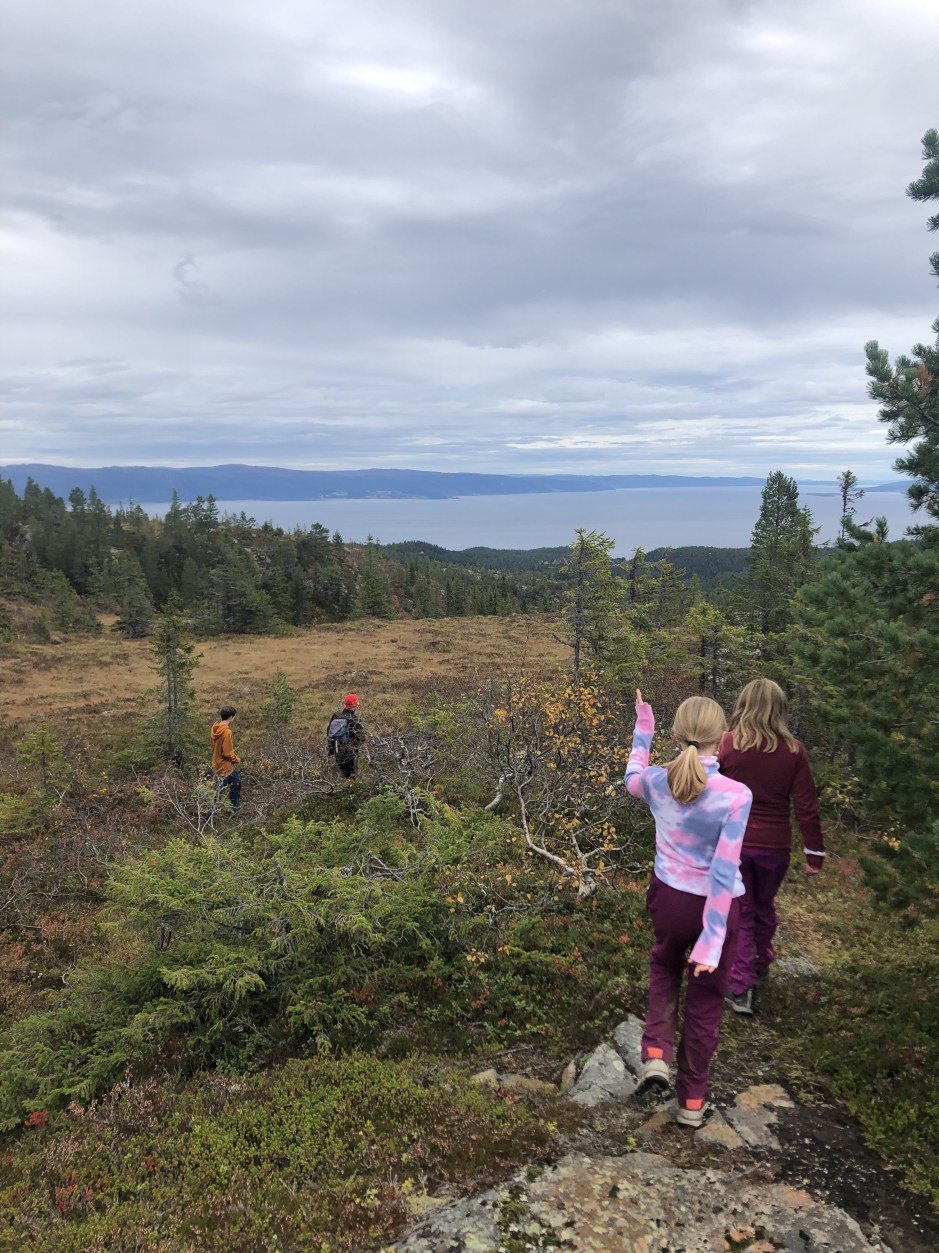
This Summer, the weather in Trondheim hasn’t been great, so we spent some time doing some home improvements, I finished some sewing projects, and we managed to take some trips to the forest too. One of my daughters and I have been also bathing quite regularly even though it is a bit cold.

Our youngest daughter is very social and has a couple of good friends in the neigborhood with whom she has been spending a lot of time. We live close to the sea, and close to a farm, and they spend their days visiting the sheep, visiting a neighbor whose dog just had puppies, and when the weather allows, at the beach.

Our oldest has had a less exciting summer, I think, and maybe that is where my anxiety comes from. He is sixteen and at what I see as a crossroads. He will start High school this Fall, and he is a bit in limbo for the moment. Not much to do. Not many friends to hang out with since some are traveling and others are busy with other friends and/or family. Although I do feel for him, I also think this is quite normal. I also went through a period like that when I was around his age.

So, why my anxiety? Well, it has taken me quite a few days to sit down and write this in my journal and realize that my worries are unfounded. It sometimes seems like ‘everybody’ travels abroad at least once a year in Norway, but although it might be true for some, it is not everybody. And why is traveling abroad better than enjoying time together in nature? Or with family? We made a choice not to travel, why spend time stressed questioning a choice I can’t change now? We do try to give our kids experiences. For us, developing awe, love, and respect for nature has been important. Not to mention joy in simple things.

Maybe what is important to acknowledge here is how everything is in constant change. Our oldest and youngest don’t share the same interests with us anymore. Thus, they don’t always want to join us for our hikes, and they might complain if we insist. But hey! that’s partly the job of a teenager, isn’t it? So why do I torture myself like this?

Being a teenager is going through so many changes, but being the mum of three teenagers also requires changes in my mindset and attitude. I realize that I try to be everything for my kids because that is what I was when they were younger. I don’t need to do that anymore. I just need to be a clear, steady, and reliable adult for them. They might not always like my choices and my ideas, but that is part of allowing them to become more steady in who they want to be. I can listen to them, and we can start making projects together instead of my husband and I deciding for everyone, but I most probably won’t always be able to or even wish to do as they want.

So, to reduce my anxiety, I need to be steady in the choices we make as the adults in the family and accept that some or many of them won’t necessarily be popular among the teenagers in the house.

Sacrifice in Karma Yoga

“Once, a fellow went into the jungle and became very tired. He foud a beautiful tree and sat beneath it. But the ground was thorny. He couldn’t lie down anywhere. ‘How nice it would be if I had a small cot!’ The minute he thought of it, he found himself sitting on a cot. ‘Oh boy, I have a cot!” He lay down. ‘This is very comfortable, but I’m also hungry. I could use something to eat, maybe a banana.’ Immediately a bunch of banans appeared. ‘What is this?’ He couldn’t believe his eyes. ‘It seems whatever I want I can get here. Then how about some gourmet cooking?’ Immediately, plates filled with delicacies, delicious dishes, pudding and desserts appeared. He ate sumptuously and then thought, ‘It would be nice if there were someone to massage my feet to put me to sleep.’ Even as he thought of it, there was already a beautiful angel-like person there massaging his feet. He became excited, ‘Oho! It looks ike whatever I’m thinking, I’m getting. Now I have a comfortable bed, a good, sumptuous meal, and somebody to massage my feet. But what if, while I’m getting the massage, I fall asleep and suddenly a tiger comes from the jungle. What will happen?’ Immediately he heard the roar, and a tiger appeared and devoured him.”

I read this story while studying Chapter 3 in the Bhagavad Gita with commentaries from Sri Swami Satchidananda. He shares this story when commenting on the concept of yadnya or sacrifice that is described between slokas 9 and 16.

Chapter 3 is about Karma Yoga which encourages us to live a regulated life where our actions are the means to our spiritual development. As you might know, the Bhagavad Gita is basically the conversation between the great warrior Arjuna and his friend and charioteer Krishna, who also happens to be a divinity, right before the battle of Kurukshetra. Arjuna is filled with fear and self-doubt and is considering leaving the battlefield. Krishna is teaching him the main principles of Yoga to help him make the right choice. I find it fascinating that the teachings of such an old scripture (it is said it was written sometime between 400 B.C. and 200 A.D.) are of so much relevance for us today. It is maybe not surprising though since the basic needs and inner struggles of humans haven’t really changed since then.

3. 9 The world is bondage when actions are done just for your own sake. Therefore, Arjuna, make every action a sacrifice, utterly free of personal attachment. Satchidananda, Sri Swami. The Living Gita: The Complete Bhagavad Gita: a Commentary for Modern Readers (p. 36). Integral Yoga Publications. Kindle Edition.

I find the idea of yadnya or sacrifice very inspiring, and I believe that learning to live following this principle would spare us and others a lot of suffering.

First of all, what is yadnya? My teacher once described it as ‘the principle of interdependence’. If you look at nature, there is a cyclic system of giving and receiving. Rain falls and all living beings benefit from it. The tree gives fruit so animals can be nourished and by doing so, the seeds of the tree are spread so more trees can grow.

3.14. From food, all beings arise. From rain, food originates. Rain is the result of selfless sacrifice (yajna). And sacrifice is the result of actions (karma). Sri Swami Satchidananda. The Living Gita: The Complete Bhagavad Gita: a Commentary for Modern Readers (p. 43). Integral Yoga Publications. Kindle Edition.

The idea of sacrifice does not mean self-neglect or self-flagellation, it means that we choose to act with awareness and with the intention that our actions not only benefit us but also the whole we are a part of. We act with a sense of purpose, with the intention to learn and grow and to contribute to the whole.

This does not mean that we all have to give up our jobs to do volunteer work. It means that wherever we are, whatever our roles are (yes, we have many so try to identify yours), and whatever we do, we are encouraged to mind our intentions and let go of the need to be rewarded (here, the principle of vairagya or non-attachment is emphasized) because if we only act out of a need for validation or greediness, we are bound to suffer. Oftentimes we will experience that the validation does not come as we expect it to be, or once we get what we want, we will crave for more falling into indulgence which can have a negative effect on us, the environment and other sentient beings.

Going back to the poor man in the jungle, he had found a source to fulfill his needs, but his uncontrolled mind brought an abrupt end to his life. This story, my teacher tells me, is used to talk about the dangers of greediness. Nature offers us what we need to survive, but we often abuse Her generosity.

3.12. “Dear old friend, you should strike a balance in life between giving and getting. When you engage in selfless service (which is sacrifice), your desires are fulfilled, unasked by nature. Righteous people give more than they receive, indebred ones get more than they give. The one who receives without giving is stealing.” Jack Hawley. The Bhagavad Gita. A Walk Through for Westerners (p.30)

We consume more than what we need because we have forgotten to take the time to see that our inner life also needs nourishment and that this cannot come from material things. Our inner growth happens through acting with a sense of purpose, offering all our actions to the benefit of the whole, to something bigger than us, and finding a way to cultivate silence so we can access our inner source of peace and contentment.

3.17. “Arjuna, those who have found pure contentment, satisfaction and peace of Atma (the True Self Within) are fulfilled. They have nothing more in this world to accomplish, no more obligations to meet. Being in the Atma, these people are beyond karma.” Jack Hawley. The Bhagavad Gita. A Walk Through for Westerners (p.31)

There are certain actions where I can easily apply this principle, and I am guessing you can identify yourself with some of them. In the context of my family, for example, or when I choose what to eat. I am also changing my ways when it comes to what I wear, what I buy, what I dispose of and how I dispose of it. There are, however, other arenas in my life where I still struggle to effectively apply this principle. I often forget it. I expect, I seek validation, and when I do not get it, insecurity arises and the cycle of stress is fired up. So, every once in a while, I have to go back to this chapter, to be reminded, to discover new ways, to hopefully internalize.

Tired

Do you have days where you feel you are not ready to face ‘the world’? I sometimes have such days. I feel tired and irritable and feel that I don’t have the energy to face whatever small or bigger challenges the day might bring… I know, it sounds dramatic, and luckily, I don’t have many of those days, but I do have them. Especially after an intense period at work and/or at home.

I try to work with my mindset, and I also try to find out why I feel like that to avoid going into that space. There can be different reasons, but what was overwhelming my mind this morning was the thought of having to ‘deal’ with teenagers the whole day to come home and ‘deal’ with my own teenagers the whole evening.

Neither my students nor my own kids are especially difficult teenagers, but I often have a feeling that as a teacher and as a mum, I am constantly negotiating with them to do what they actually don’t want to do, and trying to explain why they need to do less of what they actually do want to do.

I can go on and on in my mind about why it is so tiring and why I am so worried and wonder also if I am right or if I am exaggerating. This usually makes me feel even more tired and overwhelmed, and I start dreading certain situations that lie ahead in my day: a lesson because I know how certain students are going to behave and I am going to have to deal with it, a situation at home because I will have to be stern and I don’t feel like it.

I was having one of those clairvoyance moments by the kitchen counter this morning when I realized that all I have to do is to do my job. I just have to show up, and if the usual suspects do the usual that require me intervening, I just have to pull them aside and take that conversation all over again. It doesn’t really matter how they react to it. Whether they respond well or not, it is up to them. All I need to do is to stay calm, be clear, maybe even be stern and stop reading people so much. Stop expecting this or that, and most of all, stop dreading uncomfortable situations/conversations. They are what they are, I can make them less uncomfortable by keeping my cool and talking calmly.

I recently read somewhere something like “burnout happens when we have expectations connected to our actions”. Yoga philosophy says something similar without using the word ‘burnout’. We cultivate a peaceful state of mind by doing our best and letting go of the fruits of our actions. I think I get very tired because I am constantly absorbing my students’ and my kids’ reactions to what I say and do.

So, on my way to work today, I kept repeating to myself “be clear, be firm, but don’t get angry. If I get a negative reaction from a student, let it be”. It might sound weird, but I keep telling myself that the less I focus on what other people do or don’t do and the more I focus on what I do and why I do it, the less stressed and tired I will feel. I also think that putting my attention in myself allows me to be more mindful of how I act and why.

It turned out to be a good day at work with the usual challenges, but I think my mindset helped me stay focused and less stressed. I really need to remember this every day.

At home, things are also what they need to be. I keep choosing my battles. and reminding myself to speak calmly but firmly even if it is the millionth time I ask my youngest to pick up her dirty clothes from the bathroom floor.

Conflict and chaos

It is interesting how, with age I gain perspective, and with this perspective, I am more willing to see unpleasant situations as opportunities to grow rather than potential mini-apocalypses.

I have never liked conflict. I have always been afraid of ending up in an argument because conflict for me has always seemed as the end of something. It has taken me a while to understand that this is my attitude towards conflict, and that it is not healthy. I think it is because I know that when in conflict, we show our worst side, and I have always been afraid of my own behaviour when angry and maybe even worse, getting hurt and disappointed.

I have also seen conflict as a sign of irreconcilable differences. If we fight now, it must be because we shouldn’t even be talking to each other in the first place.

I have had a similar attitude towards chaos. I don’t like chaos. It makes me feel out of control. I don’t necessarily feel the need to be in control all the time, but I do feel that it is expected from me- as an adult, as a mum, as a teacher, as a wife- that I am in control of all situations and especially of myself. So, if I end up being in the middle of chaos, I panic, I loose patience, and I feel low self-esteem.

However, during the last few weeks, I have been changing my mind towards these two dreaded situations, and I am starting to think that they are necessary for us to recenter ourselves, create change around us and allow growth.

The key is to not let ego get in the way which, as usual, is easier said than done. Usually, when conflict arises, it is because there is a need to stop, evaluate and consider realigning ourselves. It is also a great opportunity for us to revisit our values and priorities and act accordingly. Sometimes, this might mean that we have to let go of a certain idea we have of ourself, the other or the situation we are in for the benefit of the whole.

Sometimes, when we are in the middle of a conflict, we might feel that the opposing parties want completely different things, but if we look closer, we might realise that the needs at each extreme are the same, only manifested or expressed in different ways. This can help us open up, listen, and meet the other part half-way.

Conflict and chaos, in my opinion, are not that different. They often arise when the need of a change of direction is necessary. They arise to wake us up and give us the opportunity to see things from a different perspective, learn something new and thus grow.

It does happen, that sometimes, a conflict opens up our eyes to the fact that we need to move in a different direction than the other part, and although this is sad, it is also an opportunity to let go and allow for something new to come.