More about supporting children and youth

I think I have shared before that I believe one of the most important tasks I have as a mother and as a teacher is not to protect my children and students from unpleasant situations but to help them see that they are part of life. Instead of solving their problems for them, I should help them find strategies to get through them. This view has developed through the years in both parenting and teaching. Before, I was more anxious about my children experiencing conflict, or getting physically hurt, but this changed gradually when I realized that I cannot sweep away every single moment of distress and uncertainty for them. I also became more aware of the fact that one day, they will have to stand on their own feet.

In order to stand on their own feet, they need to learn strategies to overcome challenges. They can only do this by experience. On one side, this allows them to see their strengths and continue building on them, and on the other, after strugling finding a way through, they will learn where they need to develop new skills. If every time a difficult situation arises, I step in and solve it for them, the day they encounter one as adults, they will feel helpless. They will eventually learn like we all do, but why not allow for these moments when they have my support? When I can ask critical questions. When I can point out the good in themselves that they don’t see. When we can reflect together.

On this side of the world, life is filled with distractions that trigger our instinct of seeking pleasure: social media, unlimited access to sweets, fast food, entertainment, and the list continues. Our children can easily believe that a “good life” is a life filled with pleasant experiences and entertainment where there are no challenges, no problems, and no suffering, but I think that they will end up feeling empty if they are not encouraged to rather spend more time learning about themselves, experience life in its full range, and use these experiences to figure themselves out. This includes what we would define as good or pleasurable experience, but the challenging or difficult experiences too.

As a Yoga student, I am still finding the right balance between what I like to see as frolicking through life and the inner journey. In my understanding, Yoga teaches us that life experiences are here first and foremost to bring us closer to understand ourselves, and to grow spiritually. This means that we do not need to reject life’s ups and downs. We do not need to seek the downs either. We are encouraged to open up to life as it is and learn. We are warned of the danger of getting stuck (attachment) in a world of dualities: like/dislike, pleasure/pain, and rather treat them equally calmly. This is one aspect of Yoga that when I think about it, it makes me feel uplifted, until I get stuck in a difficult situation, and have to remind myself to allow, to move through it, and let go of my judgement and my fear. This is, what I would argue is step two in the context of my reflections in this post related to supporting children and youth.

Step one is to allow for challenging situations to happen to our young ones, and to help them nagivage through them, draw the teachings from them, and to remind them that life as we experience it is filled with ups and downs and it is how we deal with them that makes the difference.

Step two would be to put more attention in their inner life to better navigate through the world and avoid either indulging and thus risking of harming themselves (over eating, becoming an addict, not sleeping enough, over training, etc), or the world around them (overconsumption being an example), and to not fear when going through a difficult patch, because they have in them what they need to get up, brush the dust off and learn.
Changes

This Summer, I am observing that I have a tendency to be anxious about my role as a mother. This feeling is rather new to me because as the mum of babies, toddlers, and young children although demanding, I felt relatively sure about what I was doing. During the last two years, however, I have become more and more worried about not having done the right thing until now, not having made good enough choices that affect my children, not giving them enough, not giving them the right upbringing, etc.

Needless to say, it is quite tiring, and I must confess that all these worries and anxieties do wake me up in the middle of the night sometimes. My latest anxiety has been the summer break. My husband and I decided not to plan any trip abroad partly because we didn’t want to have to deal with COVID-related complications during a possible trip, partly because we didn’t plan economically for it, and partly because we love spending the Summer in Norway. It is the best time to be here for us because we like riding our bikes, hiking, orienteering, bathing in lakes and the sea and lately, my husband and I have become more and more interested in learning about edible wild plants and mushrooms.

Our plan was to visit my husband’s family that we don’t meet very often in the south of Norway, stopping on the way to make it a bit of a road trip, and maybe spend some days in the mountains in the end of July. The road trip was very nice and spending time with family is always well-spent time, especially for the kids. After ten days, though, we drove back home because our cat was home alone, and although she was being fed by friends and neighbors, she is not used to us being away for long periods of time.

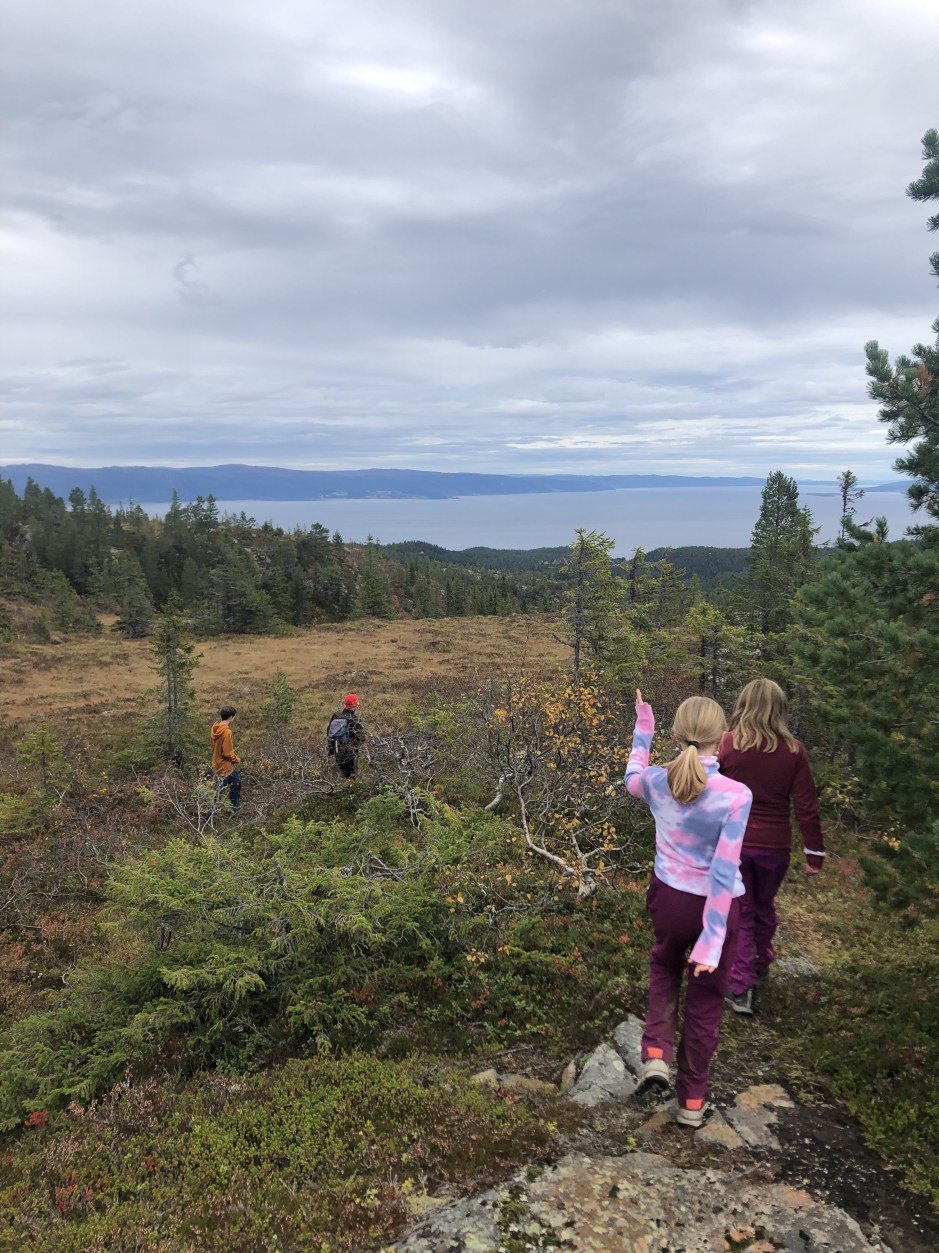
This Summer, the weather in Trondheim hasn’t been great, so we spent some time doing some home improvements, I finished some sewing projects, and we managed to take some trips to the forest too. One of my daughters and I have been also bathing quite regularly even though it is a bit cold.

Our youngest daughter is very social and has a couple of good friends in the neigborhood with whom she has been spending a lot of time. We live close to the sea, and close to a farm, and they spend their days visiting the sheep, visiting a neighbor whose dog just had puppies, and when the weather allows, at the beach.

Our oldest has had a less exciting summer, I think, and maybe that is where my anxiety comes from. He is sixteen and at what I see as a crossroads. He will start High school this Fall, and he is a bit in limbo for the moment. Not much to do. Not many friends to hang out with since some are traveling and others are busy with other friends and/or family. Although I do feel for him, I also think this is quite normal. I also went through a period like that when I was around his age.

So, why my anxiety? Well, it has taken me quite a few days to sit down and write this in my journal and realize that my worries are unfounded. It sometimes seems like ‘everybody’ travels abroad at least once a year in Norway, but although it might be true for some, it is not everybody. And why is traveling abroad better than enjoying time together in nature? Or with family? We made a choice not to travel, why spend time stressed questioning a choice I can’t change now? We do try to give our kids experiences. For us, developing awe, love, and respect for nature has been important. Not to mention joy in simple things.

Maybe what is important to acknowledge here is how everything is in constant change. Our oldest and youngest don’t share the same interests with us anymore. Thus, they don’t always want to join us for our hikes, and they might complain if we insist. But hey! that’s partly the job of a teenager, isn’t it? So why do I torture myself like this?

Being a teenager is going through so many changes, but being the mum of three teenagers also requires changes in my mindset and attitude. I realize that I try to be everything for my kids because that is what I was when they were younger. I don’t need to do that anymore. I just need to be a clear, steady, and reliable adult for them. They might not always like my choices and my ideas, but that is part of allowing them to become more steady in who they want to be. I can listen to them, and we can start making projects together instead of my husband and I deciding for everyone, but I most probably won’t always be able to or even wish to do as they want.

So, to reduce my anxiety, I need to be steady in the choices we make as the adults in the family and accept that some or many of them won’t necessarily be popular among the teenagers in the house.

Stressed and demotivated teens

I have been working as a middle school teacher for over fifteen years now, and in the last four years, I have observed an increase in the number of students who struggle with motivation, stress, and depression. There are, of course, varied reasons for this, but there is one thing I have been thinking a lot about lately: lack of clarity. I am not an expert in teenage psychology, so I wonder to which extent, it is possible to lead teenagers to create their own clarity.

Clarity of mind is something that is difficult for everyone, and often, the lack of it can be the root of our stress. When we lack clarity, we run like headless chickens from one thing to another, everything is important, everything is our priority, and we end up stressed and exhausted. We are like this plastic bag being blown around depending on the wind. Therefore, it is often a good idea, when we feel overwhelmed with stress, to take the time to stop and get our priorities clear, know what we actually want, what our assets are, and decide our own direction.

Of course, as a teenager, it is not expected to have life figured out, but I think we should talk about clarity with kids and teenagers. The big challenge here, I think, is that we live in a society that often sends contradicting messages to kids and teenagers. On one hand, many parents give more freedom to kids to do what they want at home, we struggle to keep routines in place, and protect our kids as much as we can from unpleasant situations. On the other, there is this underlying expectation that kids and teenagers have to succeed at school and have one or more afterschool activities where they also should do their best.

I have very talented students who excel in other areas than schoolwork, that already have a passion, but that have very low self-esteem because they don’t get high grades at school, and no matter how much I talk with them, they won’t believe me when I tell them that they are great. They want to do perfectly everywhere, they are very afraid of making mistakes or failing, so they often give up before they even try.

How about sitting down with our teenagers and making a list of what they do and how much time they invest in it? Then make another list of goals, and our own expectations towards them, and try to merge these into a priority list? Maybe such a conversation can also help us create some clarity for ourselves of what is really important for our children to learn in life and which expectations we can let go of.

I also feel that often, we allow teenagers to make choices they are not ready to make. This is also some sort of clarity. Since there is no clear framework for them, they can get lost in bad habits. I can see that at home with our fifteen-year-old son. Until he was around fourteen, going on a hike or a skiing trip with the family during the weekends was an expectation, but since he turned fifteen, we stopped insisting. This has resulted in him doing much less physical activity now, and I am not comfortable with it. I think we made a mistake by not pushing him to at least one trip with the family a week. It might be annoying for him, but it won’t hurt him, and it will definitely be good for him to get out, get some fresh air, and do some exercise. Not to mention spending time with his family.

Getting enough sleep is also a challenge at home. We gave in for some time during the weekends and holidays, but we realized we needed to go back to having strict routines and sticking to them with our son…Writing this, I wonder if this is where part of the confusion is.

On one side, we are not teaching our kids and teenagers anymore the importance of having routines and taking care of themselves, and on the other, we keep telling them that they need to succeed in life by doing well at school and everything else they engage in but we are not giving them the tools to do so.

I also think that although it is good to listen to our children and teens and respect their opinions, we sometimes need to make some unpopular decisions for them that we know will benefit them in the longrun. This only teaches them that they are stronger than they beieve. I saw that with one of our daughters. She hadn’t been thriving at school since she was in fifth school, but she didn’t want to change shools and my husband and I didn’t want to push her, until last year. We finially decided that it would be good for her to change environment and meet new people. It was a bit tough to begin with, but she’s doing great and I think this was a boost in her self-esteem. Not only she managed to adapt to a new school, she even made new friends! Sometimes, our kids can’t find their clarity, and we as adults, need to find one for them.

A little theory of mine

On my way home on Friday, I heard on a French radio station a program about the increasing use of laughing gas among teenagers all the way down to 14 years old and its consequences. It reminded me that not so long ago, I read in the newspaper that in certain cities in Norway, the use of cocaine and hash has become as common as alcohol among high school students. A friend of mine back in Mexico told me recently that the use of drugs among teenagers has increased in the last few years too.

I can’t help but wonder if this is not partly a result of the way my generation is bringing up our kids in what we call the “Western world”. One thing that I think kids in France, Norway, and among the middle and upper classes in Mexico have in common is easy access to what brings sensory pleasure.

We can start with food. Many kids nowadays can eat sweets and drink sugary drinks daily if they want to. What in some cultures used to be limited to special occasions or at least the weekends, has become part of everyday life. Whenever a kid feels the need to be rewarded somehow, they can do it through the sense of taste.

Another way to get an immediate reward is by buying things. It is enough for a kid to express their wish for something to get it almost right away. It can be toys at a young age, clothes, makeup, and devices. What used to be left for birthdays and Christmas, is now part of everyday life. So, when special occasions come, we tend to give more than our kids need.

Lastly, we have the immediate reward electric devices give. Either through social media or gaming.

So, my theory is that we have created a generation of pleasure seekers. Kids nowadays are used to satisfying their senses almost constantly. It is not enough to go for a holiday by the beach, there is the pressure to make it exciting for the kids. So we book activities, or rent or buy equipment so the kids do not get “bored”.

As we all know, the more we get, the more we want. There is always something more exciting to experience, something bigger, better, or tastier.

Added to this is our well-intentioned need to protect our kids. Whenever they experience something unpleasant, especially socially, we intervene. We solve the problem for them. We remove them from the situation. We demand others to solve our kid’s problems. Leaving them incapable of dealing with disappointment, sadness, or pain. We do this to protect them, but we forget that the muscle of resilience needs to be trained.

My point here is not to criticize. I belong to this generation and I have observed in myself and my husband many of the behaviors I describe here, and I wonder if we are not doing more harm than good in some cases. Wouldn’t our kids benefit from having to strive a bit more to get what they want? Wouldn’t they benefit from learning to live simple lives? Wouldn’t they benefit from learning to be satisfied inside out instead of believing that the world around them owes them and that their happiness is in how much they get and how much they experience? Wouldn’t they grow for experiencing difficult situations and getting through them?

I know that the curiosity to drink alcohol and use drugs is not new. I know that the problem of substance abuse can have many reasons, but I wonder if the unlimited and often unconscious access to sensory pleasure is not also contributing to this tendency.

It is great that we have enough to give our kids everything they need and more, but maybe we sometimes need to stop and wonder where happiness really comes from.

Reflections over a recovering broken arm.

I have three teenage kids…or almost. The youngest is turning thirteen this year, but she surely behaves like a teen already. Since they were toddlers, I have tried as much as possible to explain the whys of my behavior as a mum. Why they have to brush their teeth, why it is important to have healthy eating habits, why it is important to have a sleeping routine, why we wear a hat and mittens when it’s cold outside, and so on.

I am not sure how much they’ve listened, or how clear my explanations were because the older they get, the poorer choices they seem to want to make. Especially our oldest and our youngest. The one in the middle has less liberty because she was born with a syndrome and one of the recommendations with her diagnosis is to have very clear routines, so she knows there is little room for discussion when it comes to food, sleep, and exercise. Otherwise, she is happy to follow instructions when it comes to outdoor clothing.

Our oldest is 15 years old and turning 16 this year. The last year or year and a half, I had started to let him make his own choices more. I had stopped insisting on him wearing a hat, or mittens, or a rain jacket. During weekdays, we still insist on him going to bed as soon as he gets home from his swimming practice, but they sometimes end so late that he goes to bed at midnight. We tried to keep a routine during holidays too, but this Christmas break, we gave in and let him go to bed when he wanted, trusting that it wouldn’t be ‘too late’. It was sometimes at 2am because he was gaming online with his friends.

The struggle with our 12-year-old is food. She has always been picky, but when she was younger, we had at least the authority to make her eat what we considered healthy at each meal. Now, she can refuse to eat breakfast and no matter what we say or do, she won’t listen. She can spend hours in front of her dinner plate until we give up and let her leave the table. But make a batch of brownies and guess who will eat three in no time.

So little by little, I have been giving in to some of my kids’ poor choices explaining why I disapprove of them and why I would rather see them make better choices, but I didn’t fight, I didn’t nag enough.

Until last Saturday when our oldest broke his arm and ended up at the hospital. The whole experience made me reevaluate in many ways how we are parenting our teenagers. While our son was recovering from surgery, I sat by his side feeling overwhelmed by the love I feel for him, and although his life was never in danger this time, thinking about how frail life is. How, in just a little moment, everything can change. Do I know him well? When was the last time I had a long chat with him? Not because I didn’t want to, but because he is always ‘busy’ with something else, and I don’t want to ‘push’ him. He is a lovely kid, kind, very generous with his smiles, and very reserved. When I ask him, how his day was, his answer would always be “okay” or even “I don’t know”. As he grows older, I notice that “I don’t know” has become a standard answer. You might think – as I did – ‘what is wrong with that?’ In reality, there is nothing wrong with that answer, but I feel that it often can be a way to avoid being in contact with what he really thinks or feels because it might be unpleasant, or because he doesn’t want to take a standpoint that might put him in opposition with someone.

I don’t like making people feel uncomfortable, so, throughout the years, I have avoided pushing our son to talk or to give his opinion. Sitting by his side, remembering how stressed he was right before the anesthesia kicked in, and how helpless he seemed, I told myself that I have to push him a bit more. For his own sake. He needs to learn to notice how he feels, what he thinks and be with it. Share it. Find strategies to overcome unpleasant moments. Be brave. Stand up for his thoughts, feelings, and opinions. He will need these skills in life as he grows older and becomes more independent. It is my job to make him a bit uncomfortable from time to time because he is safe with me. He can deal with his mum pushing him, and this will train him to be ready when the world pushes him harder than me, in less safe contexts.

After the operation, and when he was back in his room at the hospital, I allowed him to check his messages on his phone and answer them, but after a little while, I took the mobile away. He was anxious about not being able to sleep and wanted it back, but I stayed firm. He didn’t sleep very well that night, but I told him that it was okay. He would have the chance to rest at home. Once at home, I have been stricter with screen time – wondering at some point if this was the right time since he is after all convalescent – and pushing him to rest and go for short walks with me. Today, during one of our walks, he told me: ‘mum, I think the medicines I got at the hospital finally had an effect on me. I feel relaxed.’ I told him I don’t think it was the effect of the medicines, it’s been already over 24 hours. It’s the effect of resting while awake and sleeping enough hours. The walking must have helped too. Me making him a good breakfast. Drinking enough water…

I have a feeling that in our modern society we tend to forget that everything in the human system is interconnected. How we feel physically, mentally, and emotionally is dependent on everything we do day after day. The quality of the food we eat, the quality of the thoughts we cultivate, the quality of our sleep, how much physical activity we include in our everyday life, how much we allow our mind and body to rest, how well we are connected with our thoughts and emotions, even how much water we drink. When one aspect of our system is out of balance, we need to look into the whole of our everyday life, and often, the solution is most probably in changing more than one habit.

As a teacher, I see the number of students struggling with sleep, motivation, and even depression increase year by year, and I think it is connected with the lack of a holistic approach to their struggles.

I notice it myself, if I am deprived of sleep, I feel more vulnerable. If I eat poorly for a day or two, I feel sad without understanding why. Some people feel irritated, some lethargic.

I will, from now on, push my kids more to face their thoughts and emotions, to go for walks with me, to eat properly, to give me their phones and turn off the computer, to go to bed early even if they dread not falling asleep right away. It doesn’t matter if they get annoyed, it is partly my job to annoy them, as long as I know it is with the intention to take care of their physical and mental health. And I will continue repeating why I do it: because I love them.