

The analogy of a fart

What on earth does this have anything to do with Yoga?!

My youngest daughter and I sometimes have the simplest funniest yet most philosophical conversations. We were walking home from the gym when she told me about an episode where someone farted at school and all she could think of was to ease the awkwardness by pretending she didn’t hear anything. I mean, who hasn’t experienced that before? You laugh too hard, you sneeze, you push a piece of furniture and the wind you have been trying to keep in your belly sees its possibility to finally get out. We then discussed how we don’t really mind other people having this kind of “accident” because we understand, but how embarrassing it is when it happens to us! When we fart, we spend at least some minutes hoping nobody heard, and if they did hear and make a fuss about it, we then feel like changing our name and moving countries. Why is this? Why are we able to show understanding to someone else in this way, but feel like our farts are unforgivable?

It’s a weird social norm, isn’t it? We all have the same issue. We eat food that creates gas in our belly and it needs to somehow get out? Still, it is so embarrassing.

The last few weeks, I went back to studying the Bhagavad Gita with my teacher Prasad, and one of the lectures this week was about verses five and six in chapter six:

One should raise the self by the self (mind) and not allow the self to sink, for the mind
alone is the friend of the self, and the mind alone is the enemy. The mind is the friend of
those whose mind has been conquered. But for them whose mind is not conquered, the mind, like an enemy, remains hostile.

The definition of yoga my teacher is operating with during this course is “the state of detachment from our attachment to suffering.” (Gita, ch. 6 v. 20). In order to do so, we need to understand certain things, one of the most important being that our mind is limited. Through introspection, we can recognize this and thus set ourselves to the task of resolving these limitations so our mind is quieter and calmer. Why do we want to calm the mind? Ideally, to be able to see beyond our body, mind, and senses and reach to a deeper part of ourselves that in Yoga is called the Self with a capital “s”. Whether you are a Yoga practitioner or not, I would argue, that most of us want to live our lives at peace. We all want happiness, and for me, an important aspect of this happiness is having a calm mind.

Going back to the quote above, to befriend the mind we need to 1) have the courage to see ourselves in the mirror with our qualities and our shortcomings, and more importantly 2) we need to accept them, embrace them, and if possible, use them in order to move towards a calmer state of mind.

By now, I am guessing you are seeing the connection with our farts. Just as we all fart, we all have our mental limitations that lead us to act in unskilful ways. More often than not, I am willing to accept this fact from other people than myself. When someone pushes my buttons, after the initial reaction, I look into the context, and this person’s patterns, and I manage to find some compassion in myself.

Our state of mind is as it is because of a series of factors that have been less than more out of our control, its patterns have been set for years. Therefore, we do better to accept that it is as it is and find a way to help ourselves through these limitations instead of judging or shaming ourselves.

I am learning to do this through my studies in Yoga but also through therapy. I have had a hard time accepting that I am a person who experiences strong emotions, and for years, I have been trying to “calm down” these emotions, especially those I consider as negative emotions by “talking to myself”. Unfortunately, this has only led to me driving myself crazy! On one side, I am experiencing the emotion, on the other I am trying to talk myself into what I consider is more sensible, at the same time the side of myself that is experiencing the emotion is convinced she’s right. It can last for days this incessant mental back and forth. I feel angry, frustrated, or sad, and then my mind makes a big mess out of it, and I end up feeling exhausted, guilty and ashamed of myself. I don’t think this is being very friendly towards myself.

Lately, I am aiming to recognize what is at the core of the emotion (this is also inspired by Non-Violent Communication by Marshall Rosenberg). Does what happened go against one of my core values, does it not fulfill a need I have? Do I need to find a constructive way to express this emotion, request something, or contribute in a way to improve the situation? Or do I need to find a way to reassure my mind and let go of the situation? In any case, what I need to stop doing is judging myself for experiencing a strong emotion because I then get lost in it.

I realize that I am a very spontaneous person when I feel grounded and safe, this makes me feel happy. Most of the time, I allow myself to be spontaneous, except when I am afraid of being judged. When I feel insecure or afraid, I can act impulsively, which often brings a lot of regret.

In either situation, I need to remind myself that, yeah, we all fart, and those that are able to see me beyond my spontaneity and sometimes unskillful impulsivity are the people that I need around me, and those who have a problem with it, can communicate it with me, I can reflect on it, apologize if needed, change something if it doesn’t go against what I believe in, and let go of people who cannot accept me as I am.

I have been too afraid of stepping on other people’s toes, on other people’s perception of myself, on not fitting in groups, places, and jobs. I have been very good at being flexible (often against what I felt was right) and adapting to situations, but this has often made me put myself and what I think is important in the background. I now know this hasn’t contributed to my peace of mind, on the contrary, it has made my inner noise louder.

It is, as my Yoga teacher keeps repeating, one of the core principles of Karma Yoga, be clear about who you are, with your strengths and shortcomings, be clear of what your values are, and act with awareness of these. Sometimes, you will manage and will be okay with your actions no matter what, sometimes, the results of your actions will not be as expected, and all you can do is get up, brush the dust, say sorry, and try again next time. Punishing yourself mentally every time you make a mistake, you fall or you step on someone else’s toes is not being a good friend of yourself.

Unskillful with balls

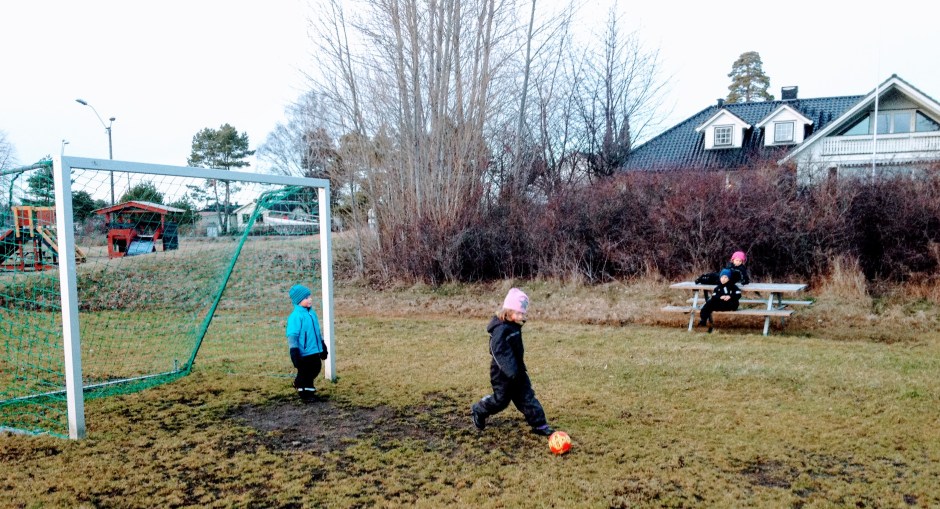
One of my colleagues who is the gym teacher at our school has taken the initiative to invite everyone at work, every Friday evening, to play in the gym. To begin with, I was skeptical since ball games have never been my strength. Mainly because I never played ball games as a child.

However, this year, I have made the resolution to be more social in my spare time, and getting together to do some exercise is in my opinion a nice way to get together.

The first Friday, I arrived ten minutes late on my bike and I saw three of my colleagues and the son of one of them engaged in playing basketball. They were having lots of fun, but the game seemed ‘serious’ to me. I stood outside the gym, in the dark, considering riding my bike back home. I felt intimidated because I would be unable to join a game like that and I didn’t want to ruin their fun. When I was about to turn away to get on my bike, one of my colleagues saw me and opened the door for me. I came in and joined them. It felt uncomfortable, but the gym teacher, who is used to students like me (haha) organized some games where I could join. It was lots of fun. I pretended a couple of times that I was very tired and needed a break, so they could also play some basketball without having to worry about me.

The next Friday, I came home from work, ate dinner with my family, and started doubting whether I should join or not my colleagues in the gym, but I decided to push myself. This time, we were even fewer than last time, the gym teacher, another male colleague, and his son. All three, quite fond of and good at playing basketball. I felt uncomfortable again, but again, the gym teacher found ways to include me in some of the games. I had so much fun, and I think I got a good workout without even thinking about it.

Growing up in a small town in Mexico, I went to a small school too. The gym lessons in primary school weren’t great, and I was not very good at pushing myself out of my comfort zone. I also played sometimes football with my neighbours, but I was very insecure, and very soon I created this idea that I sucked and that nobody wanted me to be in their team. The older I grew, the less I participated in team sports at school and with my friends. I never learned to play any of the common team sports. It was uncomfortable to not be good at something, and I didn’t have the awareness to realize that all I needed was to play and have fun, and with time, I could have maybe gotten a bit better…or not.

Last Friday, when my colleagues and I were in the gym having fun, I started thinking about all the moments I missed out as a child and teenager because I was unable to push myself beyond my comfort zone and because I was too afraid of not being skillful. So sad, I thought.

Even though my dad and some of my friends tried to convince me to be less self-conscious and join the fun, I was unable to do so. I wish our gym teachers were more inclusive, like my colleague. I don’t feel regret, and I have had a good life even if I haven’t participated in any team sports, but my point here is that I believe it is important to understand as early as possible in life that one of the best ways to interact with others is through play. The goal is not to win, nor to prove skills, but to lose yourself in a game, to learn to be part of a team, to have fun. To learn to push yourself beyond your comfort zone, and collect experiences.

Nobody knows for sure what the point of living is, but one of the things I have come to believe makes life meaningful is gathering experiences. Good and bad. Success and failure. Fun and boring. We are not here to prove something to anyone. Not all of us are here to become champions of some sort.

Tired

Do you have days where you feel you are not ready to face ‘the world’? I sometimes have such days. I feel tired and irritable and feel that I don’t have the energy to face whatever small or bigger challenges the day might bring… I know, it sounds dramatic, and luckily, I don’t have many of those days, but I do have them. Especially after an intense period at work and/or at home.

I try to work with my mindset, and I also try to find out why I feel like that to avoid going into that space. There can be different reasons, but what was overwhelming my mind this morning was the thought of having to ‘deal’ with teenagers the whole day to come home and ‘deal’ with my own teenagers the whole evening.

Neither my students nor my own kids are especially difficult teenagers, but I often have a feeling that as a teacher and as a mum, I am constantly negotiating with them to do what they actually don’t want to do, and trying to explain why they need to do less of what they actually do want to do.

I can go on and on in my mind about why it is so tiring and why I am so worried and wonder also if I am right or if I am exaggerating. This usually makes me feel even more tired and overwhelmed, and I start dreading certain situations that lie ahead in my day: a lesson because I know how certain students are going to behave and I am going to have to deal with it, a situation at home because I will have to be stern and I don’t feel like it.

I was having one of those clairvoyance moments by the kitchen counter this morning when I realized that all I have to do is to do my job. I just have to show up, and if the usual suspects do the usual that require me intervening, I just have to pull them aside and take that conversation all over again. It doesn’t really matter how they react to it. Whether they respond well or not, it is up to them. All I need to do is to stay calm, be clear, maybe even be stern and stop reading people so much. Stop expecting this or that, and most of all, stop dreading uncomfortable situations/conversations. They are what they are, I can make them less uncomfortable by keeping my cool and talking calmly.

I recently read somewhere something like “burnout happens when we have expectations connected to our actions”. Yoga philosophy says something similar without using the word ‘burnout’. We cultivate a peaceful state of mind by doing our best and letting go of the fruits of our actions. I think I get very tired because I am constantly absorbing my students’ and my kids’ reactions to what I say and do.

So, on my way to work today, I kept repeating to myself “be clear, be firm, but don’t get angry. If I get a negative reaction from a student, let it be”. It might sound weird, but I keep telling myself that the less I focus on what other people do or don’t do and the more I focus on what I do and why I do it, the less stressed and tired I will feel. I also think that putting my attention in myself allows me to be more mindful of how I act and why.

It turned out to be a good day at work with the usual challenges, but I think my mindset helped me stay focused and less stressed. I really need to remember this every day.

At home, things are also what they need to be. I keep choosing my battles. and reminding myself to speak calmly but firmly even if it is the millionth time I ask my youngest to pick up her dirty clothes from the bathroom floor.

Can you relax without stimuli?

The other day, I shared a short relaxation session with my colleagues where the main focus was to use the breath. I know that for many, the idea of sitting ‘just’ breathing sounds intimidating and maybe even boring, so I divided the session into three parts. One where we would connect the breath with soft movements (achievable for all kinds of bodies), another with a simple breathing exercise, and the last one with a body scan. The whole session lasted for approximately twenty minutes.

After the session, one of my colleagues told me it was very nice to ‘check in’ with herself. She said that while she was sitting there, she noticed how she was feeling and realized she hadn’t take the time to notice before. This reminded me of something I have been reflecting a lot about lately. It seems to me that most of us rarely take the time to slow down and just be, to check in with ourselves.

It is, of course, understandable that we all have different ways to cultivate our well-being, some choose to go for a run, others to watch a TV show, and although this does allow us to disconnect from everyday tasks, it is not necessarily bring long-lasting well being for our body and mind. During the years I have been practicing Yoga, I have come to the conclusion that there is a difference between sense indulging and self-care. I don’t necessarily think that indulging is wrong, it is nice to sometimes give in to a guilty pleasure, and as mentioned above, it can be part of our toolkit to disconnect from everyday life, but the thing is, I don’t think only indulging is going to bring real peace of mind because the satisfying feeling only lasts for a short period of time. In addition, we might seek activities that stimulate our mind and body like food, alcohol, and even entertainment, which feel good at the moment but do not allow for our nervous system to reset and restore.

I believe self-care requires more work, but less fuss. Self-care might bring some immediate comfort, and at times it can also bring some discomfort. In the long run, however, it brings peace of mind.

I might be biased by my enthusiasm towards the practice of Yoga meditation, but in my view, the only way we can really relax and take care of our well-being is by bringing silence to our body and mind on a regular basis. The challenge is, however, to have the patience to bear the noise our mind makes when we turn off the external noise. This is where the work starts because we need to learn to be with the noise of our mind as if it was background music. It is there, we notice it, but we choose not to do anything about it at that moment. We do not judge, we do not try to change it.

These moments of external silence but internal noise can be precious because like my colleague put it, it is then we have the opportunity to ‘check in’ with ourselves. We create the space to feel and think, we allow our mind to express itself. Sometimes, that is all we need. To give ourselves some ‘self-attention’, sometimes, we need further reflection on what is going on and what we need to do about it.

Making room for moments of silence and softness in our life not only helps us deal with our thoughts better, it also has an effect on our nervous system which in turn influences our state of mind. In addition, when we learn to quiet the mind on a regular basis, we are able to benefit from this practice in moments of intense distress.

To begin with, I recommend a combination of techniques like soft movement with breath for the busy mind. Practices like soft yoga asana, Tai Chi or even Qi Gong, going for a walk but with the awareness of being with yourself, with your breath, and trying to leave other distractions aside. Simple breathing exercises can also be very useful. Some help calm down the body and the mind, others are energizing. Yoga Nidra, is als a very good way to relax, and the fact that you need to focus on different body parts keeps your mind busy. If your mind is very very busy, I recommend writing. Sit in a quiet place for five to ten minutes and let words flow. No structure, no purpose, just write. Avoid reading what you write. Just leave it. This is a very nice way to ’empty’ the mind. Once you have practiced this for a while, you can start journaling. There are different ways to do it. I often like to sit down and write my reflections of the day, often, a specific aspect of it takes more place, and I discover quite a lot about myself and my interactions with the world. I often realize that something that seemed overwhelming when traped in my mind, wasn’t that bad when put into words in my notebook.

Whatever works for you, try to create at least one moment of quiet calmness in your everyday routine. With practice, you will notice the difference it makes in you. You might notice that the urge to indulge will reduce as you create more space for what I like to call ‘real’ self-care.

Fishing

Do you ever go ‘fishing’? I sometimes do, and most of the time, I end up feeling bad about myself. Or should I say worse? It has taken me some time to observe myself fishing and to understand why I do it, and I must confess that I usually notice it after I have been fishing.

To be honest, I think I am constantly fishing, but some fish are bigger than other. In some areas, I am less insecure, so whether I catch something or not is not such a big deal. For example at work, I do my best, and I absolutely enjoy it when I get some sort of validation, but if things don’t go as I hoped for, I can quickly get on my feet again and tell myself that I did my best and I can only learn from the experience.

Writing this, I guess this is not real fishing. This is just playing my part, while fishing is when some sort of inner void manifests itself, and to fill it with something, well, I go fishing.

Maybe you are starting to get what I mean by ‘fishing’? Maybe you are starting to get annoyed by me repeating the word so many times. Can you identify yourself with it?

What I call fishing is when I approach someone with the intention of getting some sort of validation. Just like little kids do, you know? You catch a young kid drawing, and you approach her with curiosity, just to hear the kid say “I’m not good at drawing”. What is the most expected reaction? Will you answer “yeah, you suck!”? Or will you say “nonsense, you’re really good at this.”? Rather the latter, isn’t it. That is what I call fishing. It is not negative, there is not bad intention, the kid is just seeking validation. We all seek sometimes validation.

The problem is where are we seeking validation? How much of our self-value are we putting on this validation? What happens when we don’t get the validation we were expecting? Because, let’s face it, even though we get some sort of validation, often, the void is so big, that reality doesn’t match the expectation. I would actually call it the unconscious expectation because at least I am not always aware of it until later. So, when the fishing doesn’t go well, I end up catching nothing else than a confirmation of my worst limiting thoughts about myself.

So what now? To be honest, not much. The void will still manifest itself from time to time, I think. I might then go fishing, but at least now, I notice the pattern before creating a big drama in my head and outside my head because I didn’t catch that impossibly big fish I was expecting. I don’t miss the hope that one day, I will notice the void and be with it without unconsciously going fishing.