Can you relax without stimuli?

The other day, I shared a short relaxation session with my colleagues where the main focus was to use the breath. I know that for many, the idea of sitting ‘just’ breathing sounds intimidating and maybe even boring, so I divided the session into three parts. One where we would connect the breath with soft movements (achievable for all kinds of bodies), another with a simple breathing exercise, and the last one with a body scan. The whole session lasted for approximately twenty minutes.

After the session, one of my colleagues told me it was very nice to ‘check in’ with herself. She said that while she was sitting there, she noticed how she was feeling and realized she hadn’t take the time to notice before. This reminded me of something I have been reflecting a lot about lately. It seems to me that most of us rarely take the time to slow down and just be, to check in with ourselves.

It is, of course, understandable that we all have different ways to cultivate our well-being, some choose to go for a run, others to watch a TV show, and although this does allow us to disconnect from everyday tasks, it is not necessarily bring long-lasting well being for our body and mind. During the years I have been practicing Yoga, I have come to the conclusion that there is a difference between sense indulging and self-care. I don’t necessarily think that indulging is wrong, it is nice to sometimes give in to a guilty pleasure, and as mentioned above, it can be part of our toolkit to disconnect from everyday life, but the thing is, I don’t think only indulging is going to bring real peace of mind because the satisfying feeling only lasts for a short period of time. In addition, we might seek activities that stimulate our mind and body like food, alcohol, and even entertainment, which feel good at the moment but do not allow for our nervous system to reset and restore.

I believe self-care requires more work, but less fuss. Self-care might bring some immediate comfort, and at times it can also bring some discomfort. In the long run, however, it brings peace of mind.

I might be biased by my enthusiasm towards the practice of Yoga meditation, but in my view, the only way we can really relax and take care of our well-being is by bringing silence to our body and mind on a regular basis. The challenge is, however, to have the patience to bear the noise our mind makes when we turn off the external noise. This is where the work starts because we need to learn to be with the noise of our mind as if it was background music. It is there, we notice it, but we choose not to do anything about it at that moment. We do not judge, we do not try to change it.

These moments of external silence but internal noise can be precious because like my colleague put it, it is then we have the opportunity to ‘check in’ with ourselves. We create the space to feel and think, we allow our mind to express itself. Sometimes, that is all we need. To give ourselves some ‘self-attention’, sometimes, we need further reflection on what is going on and what we need to do about it.

Making room for moments of silence and softness in our life not only helps us deal with our thoughts better, it also has an effect on our nervous system which in turn influences our state of mind. In addition, when we learn to quiet the mind on a regular basis, we are able to benefit from this practice in moments of intense distress.

To begin with, I recommend a combination of techniques like soft movement with breath for the busy mind. Practices like soft yoga asana, Tai Chi or even Qi Gong, going for a walk but with the awareness of being with yourself, with your breath, and trying to leave other distractions aside. Simple breathing exercises can also be very useful. Some help calm down the body and the mind, others are energizing. Yoga Nidra, is als a very good way to relax, and the fact that you need to focus on different body parts keeps your mind busy. If your mind is very very busy, I recommend writing. Sit in a quiet place for five to ten minutes and let words flow. No structure, no purpose, just write. Avoid reading what you write. Just leave it. This is a very nice way to ’empty’ the mind. Once you have practiced this for a while, you can start journaling. There are different ways to do it. I often like to sit down and write my reflections of the day, often, a specific aspect of it takes more place, and I discover quite a lot about myself and my interactions with the world. I often realize that something that seemed overwhelming when traped in my mind, wasn’t that bad when put into words in my notebook.

Whatever works for you, try to create at least one moment of quiet calmness in your everyday routine. With practice, you will notice the difference it makes in you. You might notice that the urge to indulge will reduce as you create more space for what I like to call ‘real’ self-care.
#30daysthreeminutessilencechallenge

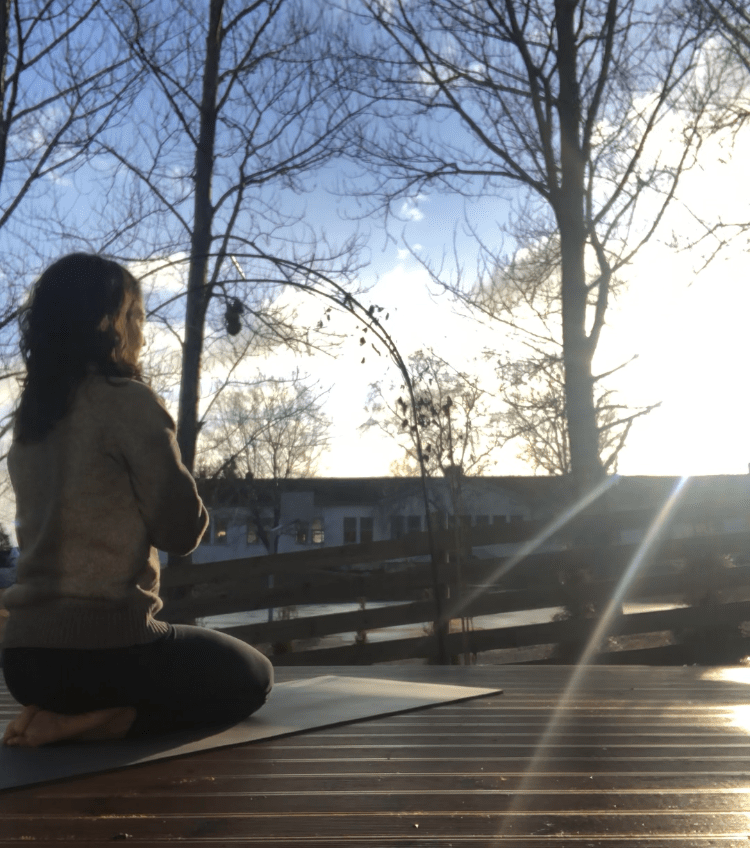
I recently started a ‘sitting in silence challenge’ on my Facebook page where I film myself guiding a three minute long meditation. I came up with the idea because I see there are often plank, push-up and burpee challenges on Facebook and Instagram. They are often intended to bring awareness to an important cause. The intention for my challenge is to encourage people to slow down and spend some time with themselves.

It is fun to see how the people taking exercise challenges seem to struggle the first days to complete the set amount of repetitions, but as they continue day after day, it seems to get easier. The same applies to meditation practices. It requires practice and patience. Just like our muscles, the mind can be trained to slow down and to focus.

I started practicing meditation about five years ago, and like many, my practice wasn’t very steady. I started for a period of time, and then left it, and then came back to it. A year ago, I made the commitment to myself that I would not let a day pass without siting in silence, and I have sticked to it. One year of daily practice, and I observe, almost every day that I come to my practice with the intention of focusing my mind, to then realise that my whole life is passing in my mind, as a movie while I sit still. Either analysis of past events, or planing my immediate and long-term future. But I don’t allow this to discourage me because I have noticed the benefits from siting with myself every day.

It is like a mini vacation from the constant flow of stimuli and information the outer world sends me. It is is a mini vacation from my almost compulsive need to do something. It slows down my body and my nervous system. When I practice in the morning, I feel it allows me to center myself before I meet the world. When I practice in the evening, it helps me unwind and get ready to rest.

In connection with this 30-days challenge, I will try to write a bit more often about meditation. One of my favourite reads is Chapter 6 from the Bhagavad Gita which is about Meditation. The beauty of Yoga Meditation is that it is not just a new activity we add to our daily schedule, it is a way of living. I love to go back to this chapter from time to time because it is so inspiring to read how we can gradually change our mindset to live a more harmonious and peaceful life.

Silence 2

I just came back from a weekend in silence. It’s been four months since the last time, and it was only during the evening of my last day that I noticed how needed this silence was. I suddenly sat down to listen to one of my teacher’s guided meditations, and after that, I didn’t stand up for two hours. I felt how my body and my mind wanted me to stay. To not move, to just be.

When I go into silence, I usually ask my teacher what he recommends me to do. This time, he recommended listening to his lectures and continue studying the Gita. The rest of the time, I know I benefit from not occupying my mind with anything else. This means reduce the use of social media to zero (I have to confess that I posted something Facebook on Saturday because I felt I would otherwise forget), no texting, no reading, no radio, no nothing.

I always go into silence with the purpose to slow down, to rest, and to observe what happens. I have learned not to have any expectations, not to have any goal other than to spend time with myself. To be honest, nothing extraordinary ever happens, but some small moments of clarity, of awareness do happen, and I treasure them. I notice better where I keep being stuck in my life, and I decide which way to go. I always come back with some keywords for myself to remember in my everyday life.

Back home, as I sat down to eat breakfast with my kids this morning, I kept thinking how much information we fill our heads with. One thing I like about being in silence is that I never get to know any personal detail of the people I share the guest house with. We meet and greet in the common areas with a smile, but we don’t ask each other the usual questions. We don’t need to. We know why we are there. Some of the most emotional moments I have experienced while being together with my sangha, in silence.

The world is not a perfect place, we humans create quite a lot of trouble around us, and nature has its own force that sometimes hits us quite hard. Life is constantly changing, and we naturally have a tendency to worry about what the future might bring. Every generation has experienced some sort of common fear, my generation is experiencing the fear of the consequences human impact has on the environment. I have been worried about this for some time too. Wondering what should I do, and often feeling bad conscience for not doing more.

What I think now is that we should be careful of what we fill our heads with. It is, of course, important to stay informed with what is happening around us, but how much information is too much information? And what do we do with this information? I believe more and more that each and everyone of us comes to this world with a set of attributes that we can use for the benefit of the whole, but not necessarily to the scale of a Hulk or an Iron Man saving hundreds of thousands of people with super powers, stunts and action.

Most of us can only be everyday heros, maybe even unseen everyday heros if we start living a life of clarity where we know our worth, where we know where we can invest our energy, and we do it, totally. We only have so much time and energy granted each day, and we all have different roles to play, so lets play well the roles we have been assigned and let others play their roles too. Stay informed and do your little (or big) to make a difference, but stop filling your mind with negativity and worry. None of them are known for helping solve any problem. Choose what you read, what you listen to. This doesn’t mean that you ignore the suffering around you, but the more negativity we fill ourselves with is not proportional to the more good we can do. Stop comparing yourself with others neither to feel ‘better’ nor to feel ‘less’. Do your part and feel thankful for being able to do so.

Slow Down!

This week was one of those weeks where I felt that I was moving against the wind. With the best intentions, I did nothing but push and push in my work. The result: conflicts with my students, misunderstandings with my colleagues and at the end of the week I was exhausted, confused and frustrated. An old and recurring question floated in my mind on Saturday morning when I woke up: Why is everyone so frustrated when I’m doing the best I can?

“Slow down, I’m in a hurry,” my grandmother used to say.

There are days, weeks, months and even years in which we feel we do nothing but run against the stream. Every day feels like a mini battle between us and the rest of the world.

There are days, weeks, months and even years in which when we go to bed, we feel that we were pushing invisible obstacles that felt very heavy.

And we keep pushing, and the body feels tired and the mind feels tired.

Our interactions with others feel heavy and a new conflict situation arises at every turn of the corner.

Unwanted words come out of our mouth, we lose patience, we lose control.

How long are we going to keep pushing? How much energy do we think we have to waste in this way?

One tool that we have and which I forgot about this week, is to slow down. Take a break, take two breaks, take lots of breaks. Play the game of paying attention to each movement we make, walk a little slower, move a little slower. In conversations, count to five or ten before answering and observe the words that come to our mind before opening our mouth. Which words are the most appropriate? Which ones will help bring the conversation to a place of dialogue and solution? And which ones won’t?

Against what and against whom are we pushing? Sometimes we behave like Don Quixote, we are fighting against monsters that do not exist. Because by going so fast, by forgetting that we have the ability of patience, our perception of the outside world and the ‘other’ is distorted.

In our hurry, we forget that everyone around us wants the same thing we do, inner peace, a happy life and freedom to be.

It is a good practice, when we feel that we are pushing, struggling and we are not going anywhere, to take the time to sit down, close our eyes and see inside ourselves. What are we really pushing against? What can we change inside ourself to help us flow and stop pushing?

Some of us find it hard to accept that in every situation, in every conflict, the best solution is to look inward. What can we change in our perception, in our desires, in our expectations to better flow? It does not mean that we should not fight for a good cause, or work hard towards some goal or dream, but pushing and pushing without getting anywhere will not help us at all. By slowing down, by giving us time to look inward, we can:

  1. Find clarity. We must take time to reflect and be clear about our objective. Take time to ask ourselves why am I doing this? Sometimes, in the rush of everyday life, we do things that we don’t even want to do, we do not have to do, and even worse, we do not even know why we are doing. We have to have our intentions clear.
  2. Filter and let go of everything we do that does not belong to that clarity. We can adjust our attitudes, our actions so that we stop pushing and start to flow.
  3. Find time to do what we consider necessary and let the rest flow. Find patience and trust that what arrives is what has to come. If what arrives is not what we want, we can ask ourselves what we can change in our way of seeing things, or doing things to be more aligned with reality. Maybe it’s not the time, maybe it’s not the best for us, maybe there’s a lesson to be learned.
  4. Take care of ourself and pay attention to our emotions. In order to do your part, you need to be well. You need to take time to reset and rest. Don’t ignore your feelings or push them away. Those emotions that you don’t like, are the ones that will teach you a lesson. Let them come, observe them, and try to understand them. Where do they come from. With practice and patience, you will see that they come from inside, from your imprints in your mind. Once you recognise the internal source, you will be able to heal them. Only taking the time to be with yourself will allow for this.
  5. Save energy and stop trying to convince others of our way of seeing things. If we make a mistake, apologise, if someone perceives our actions differently from our intention, instead of trying to convince, try to understand that perception and keep flowing.

So, my week ended with apologies given to those who were shaken by my speed, conviction that the conflict with my students was necessary to learn a lesson (from both sides), and hope that next time, I will remember to move slower.