We’re getting there

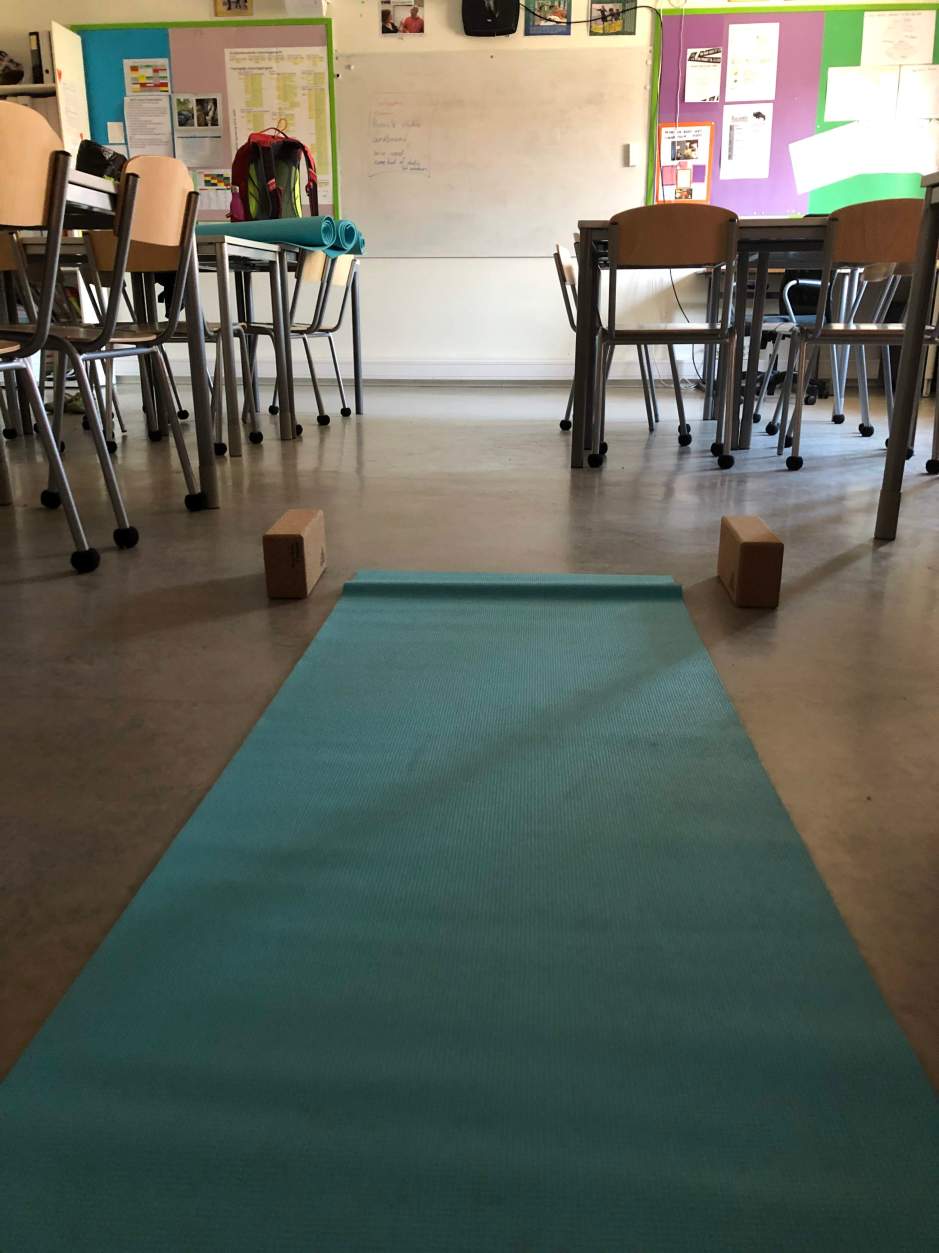
This year, I teach yoga as an elective at the school where I work. This isn’t the first time, and it is taking me many years to create a program that I feel is both meaningful and appropriate for the age of the students.

Last year, during the Spring semester, I was teaching to only tenth graders, which are around 16 year old. With inspiration from a research program I was invited to participate in called Hippocampus, I tried to create a program for those girls for that semester. It worked quite well. I introduced asana very slowly throughout the weeks. First, with mainly just some joint mobilisations and relaxing poses on the mat, and gradually, I started introducing standing poses.

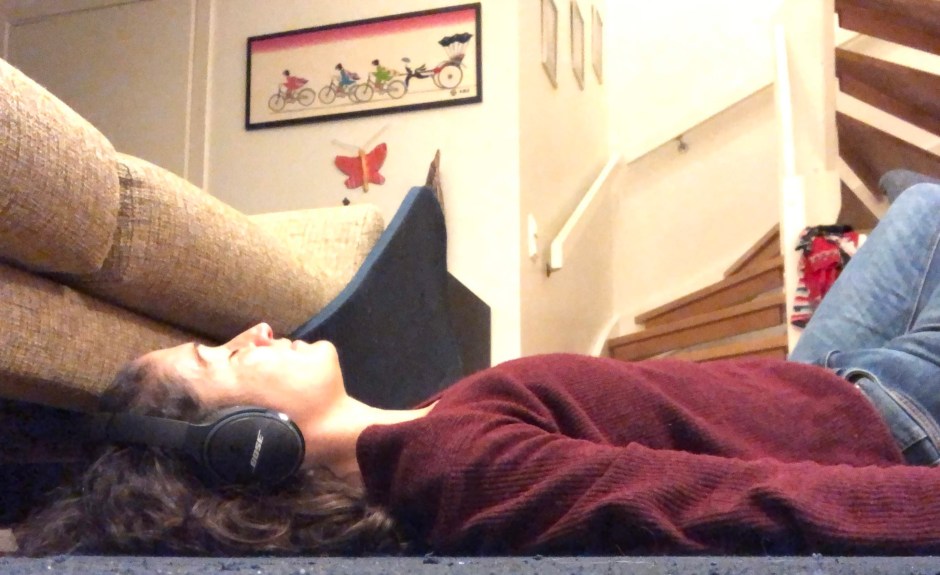
During one hour, we would only do about 20 minutes of asana, around 15 of reflection on a topic I thought was relevant for them (self-esteem, stress management, emotions, relationships, etc), and the rest of the time they lied down on their mats for a body scan and simple breathing exercises.

I felt that the girls enjoyed it and that they got something out of it, so this year, I decided to ‘repeat the success’. What I didn’t count with is the fact that these electives are open for all students between 11 and 16. I ended up with a group of 11 girls (boys rarely sign up for yoga, unfortunately) between 11 and 12 years old.

Very soon, I understood that the program I had made for yr10 wasn’t going to work. These girls are much more active, they aren’t used to be still, and they are constantly looking for each other’s attention (this is very age appropriate). It is very interesting to see, and it has been a fun journey to teach them since September.

I still feel that it is my duty to introduce them to Yoga beyond asana, so I tried to structure each lesson with a bit of asana, a reflection and some relaxation. The asana I teach is very simple because I want to move away the focus from doing ‘fancy’ poses to get to know their bodies better. Many of them don’t exercise much, and they benefit from moving their bodies and strengthening them through simple asana.

I gave them a notebook too, where they can write or draw during the lesson, and I sometimes ask them to write something in particular.

I am trying to find the balance between giving these girls the space to be who they are and how they are, and trying to guide them towards the idea of relaxing the mind and the body, and towards the habit of getting to know themselves better. It sometimes feels like my lessons are filled with chaos, especially when we do asana. There is not much breathing going on, not much focus going on, they just want to do the pose and then it turns into dancing, jumping, and running around. But when I ask them to lie down for relaxation, I do insist in silence, and I am noticing that they are managing it better and better for each lesson.

I found a book called Stories from India by Anna Milbourne at the public library, with short cute stories that invite for reflection. I am now reading them one story in the beginning of each lesson while they lie down on their mats, and we then discuss what they think is the message. This is working very well, and we like the stories in the book.

One of the girls, a seventh grader (around 11 or 12 years old), has been slightly annoyed with the fact that we don’t do more ‘fancy’ poses. During the past weeks, she keeps asking me what yoga is, but she doesn’t really wait for the answer. She is trying to figure it out herself.

This week, I did a more fun session that I found in a Yoga for kids book called Yoga games for children by Danielle Bersma. I took one of the chapters about poses and modified it slightly and we were mainly rolling up and down on the mats working with the abs. I also read a story and we discussed the message, and they did some relaxation.

At the end of the lesson, when I was tidying up my things, the same seventh grader came to me and said, “Yoga is not physical activity, is it?” Before I even tried to answer, she said “Yoga is mental training, isn’t it?” and she left. I guess it is a good definition, isn’t it?

I am grateful for this class. It teaches me so much. I am thankful for these girls and all the kids at our school that sign up. I realise that being a Yoga teacher is not different from being a school teacher. We cannot have a fixed program that fits every class. We have an idea of where we want to lead our students, but we have to adapt the how to who and where they are in life/development, and we sometimes even have to adapt our idea of what they need.

The only way out is through

I’ve learned cross country skiing as an adult, and it has taken me many years to feel more or les confident on the tracks. It is until recent years that I took the courage to try to ski down steep hills (or what I perceive as steep hills) instead of taking my skis off and walking down. I think I started skiing more often more or less at the same time as I started practicing and studying Yoga more seriously. I remember I once was skiing on my own at a place that I didn’t know very well. As I approached a downhill, I felt my body getting stressed, but I decided to give it a try. Half way through it, I started panicking until I remembered this phrase from my Yoga teacher “the only way out is through”. I was already on my way down, there was no way back, it felt like it was going to last forever, but I knew that wasn’t possible, so why not try to relax my body, pay attention to what is happening and trust a bit in myself? And it helped! I couldn’t help but thinking that it is similar to when we experience downhills in life. We panic and want to change direction, but if we remember that the only way out is through, if we spend less energy on wanting to be somewhere else or doing something different, we will feel less stressed and/or distressed, and maybe get through it stronger and wiser.

In life, the most challenging situations offer us opportunities to learn and grow but, most of the time, all we want to do is run away. You might have experienced though, that the more you avoid the challenges that life presents you, the less they disappear. Asana, pranayama and meditation are good tools to get through challenging situations because, when practiced regularly, they help us cultivate a calmer state of mind. They help us create a space to be with ourselves no matter what, and listen to what our body and mind need to tell us.

The Yoga practice is not always necessarily a pleasant one, sometimes, especially when sitting in silence, it will open windows that we would rather keep shut. We need to be brave and patient. We need to see our vulnerability, our weaknesses, our limitations. When we dare to look at things directly in the eye, we give them less power. The whole practice of Yoga is to get to know and accept yourself better. To open up to whatever is happening in your internal world. In Yoga we are encouraged to direct our attention inwards.

An important subject of study in the practice of Yoga are our emotions. Emotions are messengers from our mind. For this reason, we do better by listening to them. Let them come, observe them, take some deep breaths, and when they feel less intense, reflect. Please note that there is a difference between allowing emotions be and feeding into them. When you notice a specific emotion, you can focus on how it feels, where it feels, but avoid analysing it, or trying to change it or even worse trying to justify it. Just observe, note and try to be with it and with your breath.

We have a tendency to believe that emotions are a consequence of what happens ‘out there’ but in reality, they are the result of what in Yoga is called our ‘belief system’. Whether we like it or not, our minds are conditioned by previous experiences, personality and DNA. Every reaction we have to the external world is connected to this ‘belief system’.  More often than not, this belief system limits us. We perceive ourselves and the world out of our likes and dislikes not giving the situation a chance. I invite you to observe your emotional reactions during the coming weeks. Are you, at all times judging a situation out of your own perception? What happens when you detach from that perception? Can you feel any difference? Not that there’s anything ‘wrong’ with your perceptions but if some of them are bringing distress, they are not serving you.

What about the moments in life when we are being really challenged? When life is tough. Yoga invites us to cultivate equanimity of mind. The less energy we spend rejecting a situation, the more energy we can use to take care of ourselves and those around us and act in a skilful way. It is not always easy, especially when we are used to live in a reactive way, but little by little and with patience and practice, it is possible to keep a calmer state of mind, even in difficult situations. For this, we need to be able to see the whole picture and to remind us that this too shall pass. We have to have faith in the process, in ourselves and in the Universe.

Creating clarity of mind

“If we can understand how our mind and heart works, we have a chance to answer the question, “Why do I keep making the same old mistakes? ”When we ask ourselves, “What am I doing?” and “Why am I doing it?” our minds open.Iyengar, B.K.S.. Light on Life.

In the Yoga tradition, we are encouraged to cultivate clarity of mind. If we are clear about our purpose,  about our actions, and the intention behind them, our mind is calmer. We don’t waste energy in running from one thing to another,  and we don’t get entangled in a spiral of unconscious action.

My first question for you is: where does your clarity come from? Who do you rely on to be clear about what your roles in this life are and how to play these roles? Where do you think you need clarity?

Start by slowing down in everyday life to allow yourself to be aware. Whenever you can, help your mind be in the present moment. Not in the past, not in the future, but in the here and now. Observe yourself moving, acting and doing. What are you doing? Why are you doing that? Why are you doing it the way you do it?

The purpose is not to judge, nor to  label your actions as ‘good’ or ‘bad’. The purpose is to be curious, to be open and to create clarity. You might discover though, that there are things you do on autopilot without even knowing why, that there are things you do out of obligation, that there are things you do out of attachment, and probably, some of these actions are bringing distress and/or stress to your life. This is when you want to consider making the necessary adjustments to change the attitude (from obligation to love), bring awareness (from autopilot to fully engaged), or to let go (when the action is not in agreement with how you see yourself living your life, when the action doesn’t serve a purpose anymore).

We all play different roles in our lives. We are born into a family and become a daughter/son, sister/brother or ‘only child’.  As we grow up and we move in different arenas, we acquire more roles. How many roles do you play? How do you play these roles? How much do you attach to these roles? Can you see yourself as a complete being even if you lose one of these roles? In the Yoga tradition, we are taught that none of the roles we play in life define us. They can’t because they are subject to changing or even disappearing. What defines us is deep inside ourselves, and it is what makes us part of a bigger whole. It is what connects us  to the rest of the world too. The less we attach to these roles, the closer we are to our core. So play your roles, but let go of those that you can let go of, and be ready to let go or acquire other roles throughout life.

Connected to this idea is the importance of always playing our roles with our own personal and unique set of qualities. Although alike at the core and similar when it comes to physiology and personality, each person is unique and is encouraged to see and develop this uniqueness for his/her own benefit and the benefit of others. Be clear about who you are and what you are capable of. Stop comparing yourself with others and play your roles out of your uniqueness. 

All actions have three components: the intention behind the action, the action in itself and a reaction or consequence. This is one of the main principles of Karma Yoga. For the purpose of this session, I want to emphasize the importance of having clear intentions to our actions. This allows us to act more skillfully and also to be ready to let go of the reaction even when it is not as we expected it to be. If we interact with other people from a space of pure and clear intentions, and knowing that their own perception and experience of life influence the way they receive our action, we can then be at peace with ourselves even when things don’t go as we would like them to go. Sometimes, we act wanting to believe that our intention was one, when in reality we had another agenda. Being able to at least acknowledge this and accept the consequences of these actions bring us a step closer to clarity. We are not asked to be perfect beings, just to act in this world with an ever growing awareness and clarity. As we do so, we will be surprised (or not) to discover that our attitudes will gradually change to what is best for us in the long run and the well-being of the whole.


A very simple view on meditation

The practice of meditation in the Yoga tradition is more than sitting in lotus pose to ‘not think about anything’. It is a process that requires constant practice even -or better said especially – when we are not sitting in silence (no need to sit in lotus pose by the way).

Like in all paths of Yoga, the purpose of meditation is to help us come closer and closer to the core of who we really are, and to achieve this, the attitude we have towards our practical life needs to gradually help us cultivate a quieter, calmer state of mind. If our mind is all over the place 24/7, it is very unlikely that we will be able to sit and meditate in silence for some minutes. So it is like a circle, the practice of siting in silence with yourself teaches you to slow down, to calm down the body and the mind, at the same time as applying some basic principles to your everyday life will also help you cultivate this calmer and more harmonious state of mind that in turn will help you in your meditation practice.

This said, the best is to start somewhere, and using apps such as Head Space or Insight Timer can be a good tool to help you establish a regular practice. Both apps offer guided meditations in different styles and with different lengths that can vary from 1 minute to up to one hour or more. Spend some time exploring the different guided meditations they have and either pick a course (a set of guided meditations with a specific topic or purpose) or a couple of meditations that you like, and stick to them. You will need to try quite a few since the voice, pace and music/no music need to be suitable for you.

I recommend that you try avoiding jumping from one guided meditation to another because if you do so, all you are doing is serving your mind with some sort of ‘entertainment’.

I have tried guided meditations using these two apps, and I like using them mostly to take a break during the day, especially when I am tired, like for example those under the categories of Yoga Nidra or Body Scan, but when I want to slow down, to be with my mind, I prefer to sit down in silence and only use the timer from Insight Timer. I usually start with some simple breathing exercises, and then I sit down and focus my attention on my breath. Most of the time I start thinking about what has happened, what will happen, or what should happen, and when I notice this, I move my attention back to my breath. It is like a dance, and so we dance, my mind and I. No judgement, no pushing, just patiently observing.

Whether you choose to use a guided meditation or try sitting in silence, the very first thing you need to do is to convince your mind that you do have the time to sit down every day for at least three minutes, in a quiet space and spend some time on your own. Once you get so far, you need to have the patience and discipline to stay. Thoughts will come and go, especially thoughts about what you should be doing instead of sitting here and doing nothing. This doesn’t mean that you can’t meditate. On the contrary, it is part of the process. So just observe your thoughts come and go, let your mind tell you whatever it wants to tell you, but sit until the timer rings. With practice, it will get easier.

In this kind of practice, as with anything else you engage in, you need to have it very clear for you what it is that you want, what your motivation is. If your motivation is ‘just’ to relax and take a break from everyday life, I then think you can use any of the mentioned apps or you can also find quite a few guided meditations on YouTube. If, on the other hand, you want to cultivate a lasting calmer state of mind, you will need to do a slightly harder work and learn to sit in silence with yourself , and seek for some guidance to learn some of the basic principles of Yoga that complement this practice.

Santosha or contentment

From contentment and benevolence of consciousness comes supreme happiness’  Iyengar, B. K. S.. Light on the Yoga Sutras of Patanjali

Contentment is an important ingredient in the life of a yoga practitioner. In my understanding, we need to keep it in mind at all times during our everyday life in order to channel our energy in the right direction and cultivate a calmer state of mind but it is also something I can notice developing on its own inside me as I walk on the path of Yoga.

The what, the how and the why of contentment we try to generate.

Firs of all, what do I understand by contentment? I tried to find a translation in Spanish for one of my students but all I could find was something that translated back to English is “happy”. In my opinion, it is more nuanced than that. Being content is not necessarily being happy. Being content is more like being ‘okay’ no matter what. Noah Rasheta from Secular Buddhism defines it as ‘okayness’. This means that no matter what life is serving you today, you try to stay balanced. Why? To save energy mainly. Mental energy. If you don’t waste energy in getting all worked up in everything that doesn’t go your way, you can then direct your efforts towards dealing with the situation more appropriately. You avoid reacting out of impulse and you start acting more skilfully.

Contentment is one of the four niyamas in Patanjali’s Ashtanga Yoga. We are encouraged to practice it together with cleanliness of body and mind, sustained courageous practice, self-study and surrender to the supreme Self or God.

Being content means that when things go the way we wish them to go, we enjoy them and let go when we have to let go of them, and when things don’t go as we want, we focus on what can be done and what can be learned instead of getting lost in negativity. Not because negativity is ‘wrong’ but because most of the time, it won’t lead us towards any constructive action.

As one of my students put it today, if you get lost in negativity, you can’t get the whole picture of what is happening around you which may also include positive things. I loved this reflection!

Another way of cultivating contentment is to be tankful for what we have or for what does go as we wish it to go. It might sound difficult when we are in the middle of a crisis, but if you think about it, we can always be thankful for something: for being strong enough to endure this difficult situation, for the support we receive from others, for the food we get, the clothes we wear or the bed we sleep in.

How does contentment start growing from the inside?

When we constantly practice non-attachment to the results of our actions and at the same time put our best intentions into them.

Detachment brings discernment: seeing each and every thing or being as it is, in its purity, without bias or self-interest. Iyengar, B. K. S.. Light on the Yoga Sutras of Patanjali (Kindle Locations 774-775). HarperCollins Publishers.

It requires a lot of practice, but when we manage, the feeling is of pure freedom. When you can tell yourself: I did my part, the rest is out of my hands and you really let go. If the result is the desired one, we are thankful, if not, we try to find the lesson in it, and move on. Done. No need to dwell on it. Freedom and contentment.

When we learn to trust. Trust in ourself, trust in the journey, trust in our guide(s), and/or trust in the Universe/God or however you want to call it. You stand up, brush the dust, and keep walking.

When we understand that our inner peace is independent of external stimuli. When we understand that what lies at the core of our being is independent and unaffected by anything that is external to us.

But the individual who truly loves the soul and is fully satisfied with the soul and finds utter contentment in the soul alone, for him no duty exists.’ Yogananda, Paramahansa. God Talks with Arjuna: The Bhagavad Gita Ch11 v17